Monday, June 21, 2010

Mid June News

Tuesday 15 June & Friday 18 June

More young birds found their way into the nets this week. Approximately 75% of new birds banded were all hatch years.

We captured our first Baltimore Oriole for the year, an older (ASY or after second year) female. This bird showed more extensive black feathering in the throat than we usually see in a female and could have been mistaken for a SY male in the field, but she did have a brood patch and a short wing. We tend to band quite a few orioles in summer.

. While I haven’t found any long, pendulous nests of the oriole on the island I’m sure they are breeding there. I watched a male oriole chasing Blue Jays that were probably after young but couldn’t see the nest. During banding season I simply have no time to also look for nests.

Speaking of Blue Jays, we captured our first jay fledglings of the year. There were two caught together in a net and probably had fledged that morning as their feathers were growing in and one was still incapable of sustained flight. So cute!

We may not like the fact that Blue Jays will predate eggs and nestlings of other bird species, but they are ecologically important birds. In spring jays consume large quantities of hairy caterpillars not favored by many other birds. Their claim to fame in the fall is their ability to regenerate oak and beech forests by burying acorns and beechnuts in the ground.

I can’t believe we missed capturing any Downy Woodpeckers all spring but finally on Tuesday we recaptured this male originally banded as hatch-year in July of 2006. Woodpecker tails are very short and stiff which helps them maneuver on tree bark. Their zygodactylous feet (two toes in front and two toes in back) and short stubby legs also aid in climbing trees.

A sure sign this is a young Northern Cardinal (pictured below) is a brown bill. As summer moves into fall the bill gradually becomes orange and will be completely orange by winter or following spring. The red body feathers growing in indicate a male. Cardinals are notorious for hurting when they bite. Some net extractors will give the cardinal a stick to chomp down on while taking them out of the net. My husband Bill claims he can tell a young bird from an adult because the young will hold on to the stick and the adult knows the difference between wood and a finger and isn’t fooled by that trick for too long!

On Friday we captured a juvenile Tufted Titmouse. Both males and females look alike.The ring around the eye is lime-green colored (top photo) and gradually changes to gray as the bird ages. (SY in spring -bottom photo).


Another new species for the year was an Ovenbird we captured on Friday. This bird was a male in full breeding condition but most likely was not breeding on Wing Island. This species prefer large contiguous forests of at least 50 acres for breeding. We’ve captured many Ovenbirds in the past at our breeding birds banding site in the Punkhorn, an 869-acre parcel of town owned land in Brewster, but Wing is just too small in area to support breeding populations.
Both sexes sport an orange crown with black side stripes on the head. Ovenbirds have a loud, accentuated song which sounds like, “teacher, teacher, teacher!!!” They are secretive birds, however, so are not often seen in woodlands. Their large eyes are perfect for spotting insects typically found in leaf litter. The name comes from the shape of their nest said to resemble a Dutch oven. It is built on the ground in a shallow depression and is made from leaves, grasses, and other plants with a side opening.

We  captured two more hummingbirds this week, both adult females, along with chickadees, Carolina Wrens, Common Yellowthroats,  Gray Catbirds, and goldfinches not mentioned this week.

Thanks to Jennifer Dooley who helped out both days. The following birds were seen, heard, or captured from 15-18 June. Numbers reflect captured birds only:

Total birds: 41                            Total species: 40
Total banded species: 13            Birds/100 net-hours: 25


Osprey
Willet
Laughing Gull
Ring-billed Gull
Herring Gull
Great Black-backed Gull
Mourning Dove
Ruby-throated Hummingbird- 2
Downy Woodpecker-1
Yellow-shafted Flicker
Eastern Phoebe
Tree Swallow
Barn Swallow
Blue Jay- 2
American Crow
Black-capped Chickadee- 7
Tufted Titmouse- 1
White-breasted Nuthatch
Carolina Wren-2
Eastern Bluebird
American Robin
Gray Catbird- 7
Cedar Waxwing
European Starling
Yellow Warbler
Pine Warbler
Prairie Warbler
Ovenbird- 1
Common Yellowthroat-6
Northern Cardinal- 2
Eastern Towhee
Chipping Sparrow
Saltmarsh Sparrow
Song Sparrow- 6
Red-winged Blackbird
Common Grackle
Baltimore Oriole- 1
House Finch
American Goldfinch- 3
House Sparrow

Sunday, June 13, 2010

We Have Babies!

Wednesday, 2 June - Saturday 12 June

The nets took forever to open on Wednesday morning and since I was alone this day I only opened a portion of them. Rain the night before made everything a soppy mess, nets and vegetation included. It was a quiet day with only 10 birds captured. With not much activity I closed early to weedwack net lanes. I did manage to capture a beautiful Cedar Waxwing, adult male, whose feathering never fails to impress me with its velvet-like quality.

Male waxwings have extensive black feathering under the chin shown somewhat in the following picture(below top) compared with females (below bottom).

The red, waxy-tipped extensions to the secondary flight feathers of the male banded on Wednesday pointed towards an older adult which we would term ASY or after second year. A yellow band is apparent on the tips of the tail feathers with width being an indicator of age. The tips can occasionally present with an orange color depending on types of berries the birds consume.

The red appendages are actually a pigmented  extension of the feather shafts.

I captured four more Tree Swallows, one on Wednesday and three on Saturday. These birds spend most of their time in flight and their long wings are perfectly adapted for amazing acrobatics.They circle and glide grabbing insects while flying.

Tree Swallows don't spend much time on the ground perching instead on wires, bare branches, nest boxes, and one male likes to perch on top of one of the net poles! Because of this they have evolved with short, little legs.


The first weekend in June was windy and wet so I didn't band again until  Monday the 7th. The best bird of the day was probably another Traill's Flycatcher.


There are times when we come upon a net and encounter something other than a bird. We've had clam shells, frogs, June bugs, bumblebees, and sometimes mammals to name a few. How would a clam shell get into a net you may ask yourself? It can only be from a gull dropping it overhead I would imagine. So as I'm closing on Tuesday I saw something jumping around in the net on the bottom tier. Not a bird I told myself. When I got up to it I saw it was a squirrel. Good thing Gretchen isn't here I thought. Gretchen's been banding with me for the past eight years and she doesn't have a fondness for rodents. But I have to say she's been a brave trooper taking out meadow voles and chipmunks occasionally but they still give her the creeps. I don't have that aversion to them. Anyway when Gracie got near the squirrel it began shrieking so she immediately backed off. It wasn't really tangled and I merely had to pick up the netting and empty it out. Well much to my dismay instead of running away it crawled up my leg and onto my back til I let out a few shrieks myself and thankfully it jumped off onto a tree. I had a good chuckle thinking of what the scenerio would have been had Gretchen been there instead of me. It probably would have gone something like this, "OK Sue, I've had enough, I've weathered tick bites, mosquito bites, heat, cold, brambles, poison ivy, falling in canals, pouring rain, getting my boots stuck in mud so I can't move but I have to pull the plug when it comes to rodents!!"

I digress, onto birds.


Wednesday was fairly slow too but did encounter another female hummingbird, always a treat

and Song Sparrows, robins, chickadees, Redwing Blackbirds, and a Carolina Wren. They are the squirmiest birds in the hand. I was lucky to get this picture.


For many years I've pulled ticks off birds for a study of birds that act as hosts for pathogens causing human disease. I did this in cooperation with entomologist Dave Simser, the Barnstable County Extension tick man. The tick program lost its funding so for the past and current season ticks are removed from birds for Yale University. They are looking for different strains of Borrelia, the spirochete that causes Lyme disease, because it is their belief that different strains are more virulent causing people to become sicker. I've been finding quite a few ticks this past week. Here is a robin with a tick in front of its eye. If you look closely to the right of the eye and below the white clump of feathers you might be able to see a small gray lump. That is a nymphal tick. They favor moist areas such as the gape (side of the mouth) or the eyes.
                                   
Birds that spend the majority of their time on the ground such as robins, Carolina Wrens, Eastern Towhees, Song Sparrows, catbirds, Common Yellowthroats, and Hermit Thrushes are more susceptible to these parasites.

Bird numbers picked up on Saturday with 50 birds. That is the highest number of birds we've ever captured in one day in June. And we had our first babies! This is also the earliest we've had hatching years (juvenile birds) in the nets since I started banding on the island. I think it was because of the beautiful warm spring we had and not many broods were lost to cold and rain. Here is a picture of a mother chickadee and her baby:

The yellow gape is still visible on the chickadee baby.


We also had a baby cardinal, which I neglected to get a picture of, a House Finch (pictured below) of unknown sex as males won't start to attain red plumage until their first prebasic molt,
and numerous Song Sparrows. Song Sparrows have relatively long tails and this newly fledged youngster's tail was still growing in


The babies and moms are banded and measured as quickly as possible. We bring young birds back to the same net where they were caught in case they are still dependent on an adult. If a parent is caught with them we release them all together.

Thanks to Gretchen for helping with banding on Saturday. The following birds were seen, heard, or captured from 2-12 June. Numbers reflect captured birds only:

Total birds:  93                            Total species:  46      
Total banded species: 17              Birds/100 net-hrs: 22

Great Blue Heron
Canada Goose
Turkey Vulture
Osprey
Red-winged Blackbird
Black-bellied Plover
Piping Plover
Willet
Laughing Gull
Ring-billed Gull
Herring Gull
Great Black-backed Gull
Mourning Dove
Ruby-throated Hummingbird- 2
Yellow-shafted Flicker
Traill's Flycatcher- 1
Eastern Phoebe
Eastern Kingbird
Tree Swallow- 4
Barn Swallow
Blue Jay
American Crow
Black-capped Chickadee- 16
Tufted Titmouse
White-breasted Nuthatch
Carolina Wren- 1
American Robin- 3
Gray Catbird- 21
Cedar Waxwing- 3
European Starling
Yellow Warbler
Pine Warbler
Prairie Warbler-1
Common Yellowthroat- 18
Northern Cardinal- 2
Eastern Towhee- 1
Chipping Sparrow
Saltmarsh Sparrow
Song Sparrow- 14
Red-winged Blackbird- 1
Common Grackle- 1
Brown-headed Cowbird
Baltimore Oriole
House Finch- 2
American Goldfinch- 3
House Sparrow

Tuesday, June 1, 2010

Migration Comes to a Halt


Delightful weather enabled banding 7 days this past week. Even at the beginning of the week migration had came to an abrupt halt. Birds captured were few and far between as many of them are busy with nesting activities and those moving northward have already done so. Tuesday was my busiest day with 32 birds captured. Our first robin caught this spring was a second year male in full breeding condition, primed and ready!

I was happy to hear bobwhite calls as I made my rounds. Last fall approximately 25 young were released on the island and I don’t think too many survived the winter.

I also spotted Saltmarsh Sparrows (formerly Saltmarsh Sharp-tailed Sparrows) this week but they eluded our nets. There has been one in the same spot in the marsh and I’m hoping its breeding there.

Wednesday brought a special bird, a species we don’t capture too often. A Black-billed Cuckoo!


Their numbers fluctuate from year to year depending on food availability. They enjoy caterpillars immensely. This bird can have a complete molt in its first year, so I was unable to determine if it was a second year bird or older. Banders then have to age the bird as AHY (after hatch year). I also had to sex the bird as unknown, although the wing was very short leading me to suspect male, which tend to be smaller in this species. This bird presented with a brood patch, but both sexes are known to incubate eggs.


Note the beautiful red orbital ring surrounding its eye. In juvenile birds this appears as a dull greenish color, but changes gradually to a red color of the adult through winter and spring.


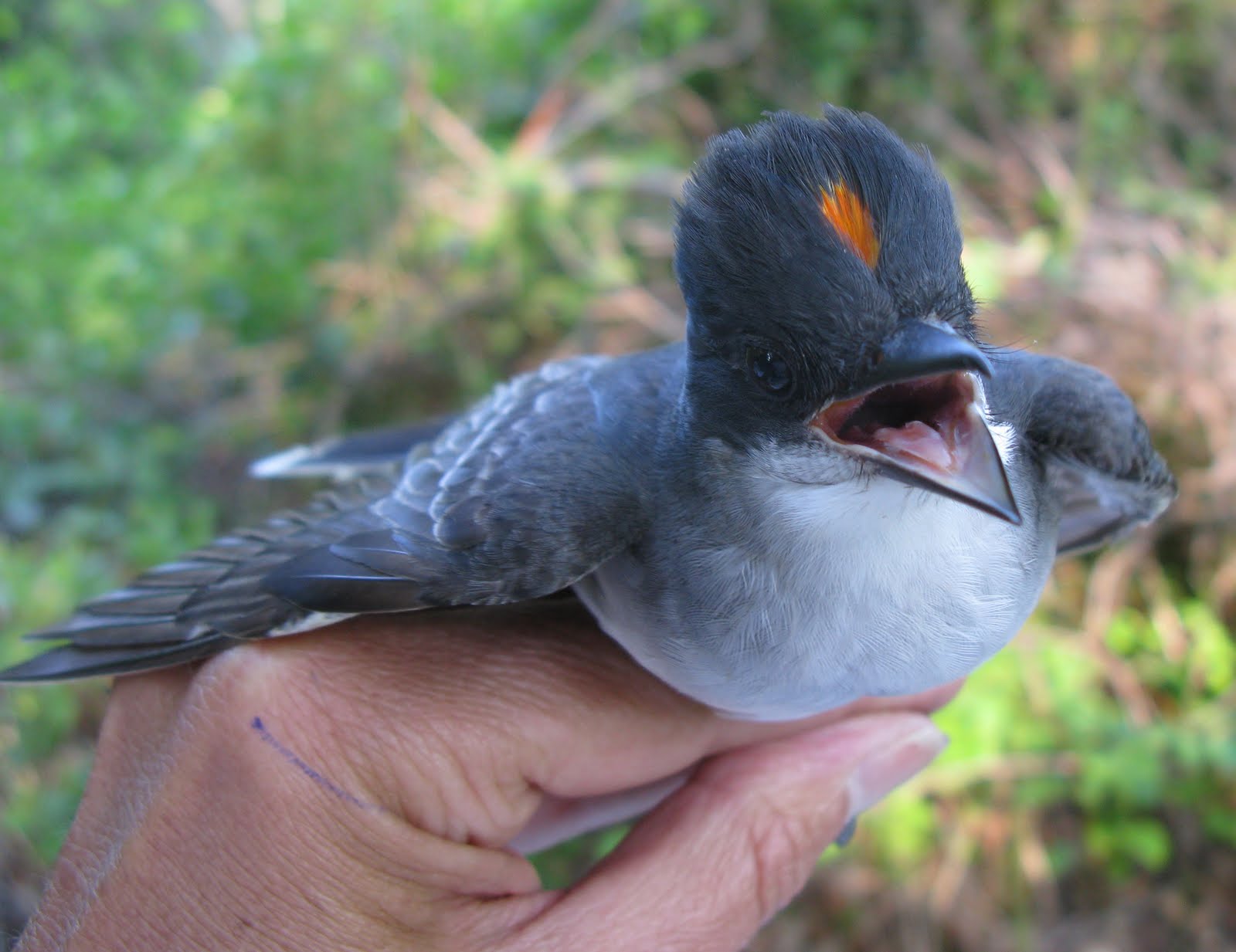
Another fine bird captured on Wednesday was a female Eastern Kingbird. She had a brood patch, her wing length was too short for a male and her outermost primary feather also pointed to female. Kingbirds breed on the island and we can hear their static-like song throughout the meadow. They belong to the family of flycatchers and capture insects on the wing.

Those who haven’t seen a kingbird up close may not realize it sports a beautiful orange patch on its crown.


Another bird captured today was a Gray Catbird that felt enormous when I took it out of the net. During banding I noticed a huge fluid filled area on its chest/abdomen. I’m inserting this picture in the hopes that another bander might recognize this condition. Fluid filled the right side of its body from the fulcrum down to the cloaca. Any thoughts would be appreciated. The normal red muscle color on the birds left is barely perceivable and the abdomen was fully feathered.


On Friday the only different species I had from the rest of the week was a male European Starling.

The starling is an introduced species brought over sometime in the nineteenth century. Their sheer numbers and aggressive behavior cause them to be disliked by many people, but one cannot deny the stunning beauty of their shimmering feathers up close.


This was the week for blackbirds. On Sunday we captured both  male (top) and female(bottom) Red-winged Blackbirds. You can see by the pictures below how different they look. Plumage in the female is cryptically colored to enable them to hide in marshes where they nest.


Common Grackles also belong to the Blackbird family. They are fairly big birds and their toenails really hurt when pressed into your fingers! They too have stunning shimmering feathers.

We closed the nets up early on Monday. Bird activity was very slow and I have to say I was ready to head home after a long week of banding. We did manage to capture our first male House Finch (another introduced species) of the year. You can see the typical streaking of the undertail coverts in the picture below not usually present in Purple Finches in the east. The bill also has a substantial curve to it. Another good indication this is a House Finch is the fact that it didn’t bite! Purple Finches are more aggressive when handled.


With migration coming to a close and birds busy with young, I won't be banding as often in the summer. I usually try to sample the area two/three times a week specifically targeting ticks we pull from birds. I may be posting every other week unless there are some great birds to share!

I want to thank bander Gretchen Putonen for running the banding station when I was away on Saturday and for banding with me all weekend. Many thanks also to Carolyn Kennedy, Judy Keller, and Judith Bruce for helping out this week. The following birds were seen, heard, and/or captured from 25 – 31 May :


Total birds: 147     Total species: 52      Total captured species: 20 Birds/100 net-hours: 18


Great Blue Heron
Canada Goose
American Black Duck
Mallard
Osprey
Northern Bobwhite
Black-bellied Plover
Greater Yellowlegs
Willet
American Woodcock
Laughing Gull
Ring-billed Gull
Herring Gull
Great Black-backed Gull
Common Tern
Mourning Dove
Black-billed Cuckoo- 1
Great Horned Owl
Ruby-throated Hummingbird-1
Downy Woodpecker
Yellow-shafted Flicker- 1
Eastern Phoebe
Great Crested Flycatcher
Eastern Kingbird- 1
Tree Swallow- 1
Barn Swallow
Blue Jay
American Crow
Fish Crow
Black-capped Chickadee- 9
Tufted Titmouse
Carolina Wren
American Robin- 1
Gray Catbird- 44
Northern Mockingbird
Cedar Waxwing- 1
European Starling- 3
Yellow Warbler- 3
Pine Warbler- 2
Prairie Warbler- 8
Common Yellowthroat- 31
Northern Cardinal- 4
Eastern Towhee
Saltmarsh Sharp-tailed Sparrow
Song Sparrow- 7
Red-winged Blackbird- 3
Common Grackle- 1
Brown-headed Cowbird
Baltimore Oriole
House Finch- 2
American Goldfinch- 23
House Sparrow

Sunday, May 23, 2010

Warbler Week

Blackpoll Warblers arrived on Monday this week and I was able to get a picture of both a male and female. Male blackpolls (top photo) are one of those species that look extremely different in spring and fall. He is beautifully adorned with an extensive black cap and black streaking on its breast in spring but after molting resembles his female counterpart in fall (dull-colored second year female in bottom photo).


Here is a comparison photo of two older adult male/female blackpolls posing nicely for their picture in spring.


Sometimes I’m lucky and capture two birds of the same sex and species but different ages so I can do a side-by-side comparison. Below are two male Yellow Warblers caught on Tuesday. The bird on the left is a second year male (born last year) and the more brilliantly colored male on the right is an older bird.


Additional warbler species captured this week were Black-throated Green Warblers, one of our smaller warblers. There were quite a few around on Monday as I could hear males singing their distinctive songs, “trees, trees, murmuring trees,” or “zee-zee-zee-zoo-zee!!!”

Monday and Saturday were the two best days of the week for numbers and diversity. I banded 4 Ruby-throated hummingbirds on Monday, quite a few considering we typically only get 1 or 2  in the nets for the whole spring season. Two groups of school children had the opportunity to see one of them up close. I had a nice male showing off his gorgeous red gorget.


Flycatchers can pose a challenge for bird banders. There are quite a few varieties that resemble each other. We take numerous measurements, comparing different flight feathers including length and shape, leg color, and body plumage color before we make our determination. Monday I was delighted to capture this Traill’s Flycatcher.

In reviewing these photographs I’m noticing while the birds are lovely, my manicure habits leave something to be desired! Oh well, as an “outdoorsy” type of gal, unfortunately my nails are the last thing I think of, so I must apologize. Focus on the birds please!

We have a table set up on the island where we spend the morning processing birds we capture. On Monday I returned to the table after a net run and my banding dog, Gracie, became quite agitated and barked at something in a tree. When I looked up I saw a Turkey Vulture quite close to us. It’s not often one is able to get close to these birds and the few times I have I’m always amazed at how really big they are! Its massive wings were evident when it took off. I thought it was odd to be there, but didn’t think too much about it again until the next day. Ooo-eeee, what a smell!! I’m thinking dead deer. Actually I’m hoping dead deer and not something more sinister. The vegetation is so thick that it was impossible to look for the source. It was not a pleasant day trying to process the birds on Tuesday, but I did see two vultures circling overhead .Wednesday was a rainy day with no banding. By the time I returned on Thursday the smell had disappeared. The scavengers thankfully did their job!

Speaking of Gracie, you can learn more about her duties on my website: www.wingisland.org/volunteer.htm. Gracie’s been banding with me since she was a pup. Her favorite bird is, take a guess, catbird! She really has no interest in other birds. Here she is intently watching bander Gretchen Putonen weighing a catbird.

The highlight of the week has to be a bird I’ve been waiting a long time to band. This primarily southern warbler showed up in the nets on Saturday. I was so thankful I had Gretchen with me to share this special bird. A KENTUCKY WARBLER!!


Thanks very much to Gretchen Putonen and Judith Bruce for helping with banding this week. The following birds were seen, heard, and/or captured from 17-23 May. Numbers reflect captured birds only:

Total birds: 195    Total captured species: 18   Birds/100 net-hours: 25
Double-crested Cormorant
Great Blue Heron
Brant
Canada Goose
American Black Duck
Mallard
Turkey Vulture
Osprey
Red-tailed Hawk
Northern Bobwhite
Black-bellied Plover
Greater Yellowlegs
Willet
Ruddy Turnstone
American Woodcock
Laughing Gull
Ring-billed Gull
Herring Gull
Great Black-backed Gull
Common Tern
Mourning Dove
Ruby-throated Hummingbird- 4
Belted Kingfisher
Downy Woodpecker
Yellow-shafted Flicker
Eastern Wood-Pewee
Traill's Flycatcher-1
Eastern Phoebe
Great Crested Flycatcher
Eastern Kingbird
Tree Swallow
Barn Swallow
Blue Jay- 1
American Crow
Fish Crow
Black-capped Chickadee- 10
Tufted Titmouse
Carolina Wren- 2
American Robin
Gray Catbird- 54
Cedar Waxwing
European Starling
Yellow Warbler- 6
Magnolia Warbler- 7
Black-throated Green Warbler- 2
Pine Warbler
Prairie Warbler- 5
Blackpoll Warbler- 3
Black-and-white Warbler
American Redstart
Kentucky Warbler- 1
Common Yellowthroat- 53
Canada Warbler- 1
Northern Cardinal- 4
Eastern Towhee
Chipping Sparrow
Savannah Sparrow- 1
Song Sparrow- 10
Red-winged Blackbird
Common Grackle
Brown-headed Cowbird
Baltimore Oriole
American Goldfinch- 30
House Sparrow


Sunday, May 16, 2010

Banding Demonstration


I enjoyed 4 days of banding this week. On Monday 40 delightful people from the Nauset Newcomers Walking Group joined me for a banding demonstration.

Many were thrilled to be able to hold and release birds they could see up close. The highlight of the morning was a female Ruby-throated Hummingbird, the last bird of the morning. When I asked if someone would like to release the bird, Barbara Murphy stepped forward and could barely contain her excitement. I'm always thrilled to see that enthusiasm!


The bird stayed on her hand for a few minutes before flying off.  

The rest of the week proved to be uneventful. Wing Island is not the best migrant trap in spring!! However it is always nice to capture a beautiful warbler, and this Yellow Warbler fits the bill. They breed in our area and are a welcome sight in the nets. This bird was born last year and aged/sexed as a second year male.


Winds were from the NW and quite blustery all week, not a good combination for banding birds. On Saturday we captured numerous Common Yellowthroats among other species. Interestingly, I noticed a distinct difference between the coloration on two male yellowthroats. One had the typical yellow color to the throat that we usually see, but the other one had a orange cast to its throat.
I've only noticed this in the past few years as Tartarian Honeysuckles have made their presence on the island. This plant generally has pink or red flowers and birds who eat the fruit often have a more orange coloration to their typically yellow feathers. I've seen this in Praire Warblers, the tips of tail feathers of Cedar Waxwings, and Baltimore Oriole feathers take on a reddish tone.


I heard Magnolia Warblers singing on the island both Saturday and Sunday but we only captured a few of them. They breed in Western Mass, Vermont, New Hampshire, Maine, and Canada and are just passing through our area, but they are one heck of a beautiful bird!!
We had 26 returns of birds banded in previous years, the oldest being a Gray Catbird and an American Goldfinch both at least 6 years old.

Many thanks to Carolyn Kennedy and Judith Bruce who helped at the banding demonstration on Monday. Thanks also to Gretchen Putonen who helped both days on the weekend, Roger Mongold on Saturday, and Carolyn on Sunday. The following birds were seen, heard, and/or captured from 10-16 May. Numbers reflect captured birds only:
Total birds: 116     Total captured species: 17  Birds/100 net-hours: 21
Double-crested Cormorant
Great Blue Heron
Brant
Canada Goose
Osprey
Greater Yellowlegs
Willet
American Woodcock
Laughing Gull
Ring-billed Gull
Herring Gull
Great Black-backed Gull
Mourning Dove
Black-billed Cuckoo- on musuem property on other side of road
Ruby-throated Hummingbird- 2
Belted Kingfisher
Downy Woodpecker
Hairy Woodpecker
Yellow-shafted Woodpecker- 1
Eastern Wood Peewee
Eastern Phoebe
Great Crested Flycatcher
Tree Swallow
Barn Swallow
Blue Jay- 2
American Crow
Fish Crow
Black-capped Chickadee- 10
Tufted Titmouse- 2
Carolina Wren
American Robin
Gray Catbird- 37
Cedar Waxwing
European Starling
Yellow Warbler- 2
Magnolia Warbler- 3
Pine Warbler
Prairie Warbler- 3
Common Yellowthroat- 33
Scarlet Tanager
Northern Cardinal- 1
Eastern Towhee- 1
Song Sparrow-9
White-throated Sparrow- 1
Red-winged Blackbird- 1
Common Grackle
Brown-headed Grackle- 1
Baltimore Oriole
American Goldfinch- 7
House Sparrow