Thursday, June 2, 2011

Last Ditch Effort

25-30 May

This week was a last ditch effort to hopefully add a few more migrants for our spring list, but the nets were fairly quiet. Blue-headed Vireos were heard singing near the banding table both on Wednesday and Sunday but none were captured. Wednesday I heard a Black-billed Cuckoo singing from across the marsh. He didn't get captured but we did manage to band an American Redstart, a second year male.

Male redstarts won't resemble the adult until they go through a molt in their second year after breeding. Some black feathers are usually visible by spring and this male has black feathers in the face, throat, and breast.

Redstarts get their name from the reddish orange tail feathers seen on the adult male. Apparently 'start' is an old name for tail. They are often seen flashing their tails as they flit about capturing insects and often do during the banding process too.

They have whiskers called rictal bristles on either side of the bill similar to flycathers, supposedly an aid in capturing insects. You can see them on the left side of his bill.

Another nice bird on Wednesday was a second year male Magnolia Warbler.
Magnolia Warblers go through a prealternate molt during the winter as they get ready for the breeding season, replacing some body and wing feathers. Older adult birds will display 2 generations of feathers in the wing, those that were replaced during their annual molt and those replaced during the prealternate molt. Second year birds will show 3 generations of feathers as was the case with this male. He replaced his inner greater coverts (the shorter feathers with white tips second row down) during the prealternate molt, the remaining outer greater coverts were replaced last fall, and the primary coverts (the smaller browner feathers towards the distal end of the wing) are retained juvenal feathers.

Another Ovenbird showed up too. If you look closely in the lower left corner I unknowingly got part of a beautiful spiderweb in the picture! I'm always amazed at the size of their eyes compared to the head. They prefer to live in large tracts of forest so large eyes would be an advantage in the low light of the woods.

We captured a female Blue Jay with a brood patch. She was first in line to be banded to get her back quickly to her nest.  She posed nicely enabling me to get a quick picture of her. Her blue coloration is not due to blue feathers but something called Tyndall scattering. When light strikes air filled cavities in the feather barbs it produces the blue color we see.

I was able to age her as a second year bird due to the molt limit in her wing. You can see the replaced longer, brighter blue and wider black bars to the inner greater covs compared to the retained outer 3 greater coverts. Also the retained juvenal primary coverts have no barring.

I was able to get out again on Thursday the 26th. Boy did it feel nice to have two sunny days in a row! Felt good for the soul and I think the birds appreciated it too as there was an abundance of bird song. I watched a brilliantly colored male Indigo Bunting in the field at the same time crows were incessantly mobbing a Red-tailed Hawk. The hawk was working the field from north to south perching in a tree near the bay and then would fly to the next tree in a southerly direction. Even the mockingbirds got in on the act of attacking him, but once he moved out of their territory they settled down. I'm a bit surprised they haven't attacked me yet as I'm sure I pass their nest on the way to some of our nets. Mid morning I captured a pair of Eastern Kingbirds, but otherwise no birds of great interest, just the usual suspects. It was great to be able to compare the male and the female kingbird. The plumage is the same for the two sexes, however I did notice an interesting difference in the color of the inconspicuous orange crown feathers. Directly below is the male

whose red crown appeared more brilliantly colored and darker than the female pictured below

The female's wing length was quite short, totally out of  range for a male, plus she had a brood patch. The notch on the outer primary feather (p10) is shorter than the male also. You can see a slight difference in length between the two sexes. First the longer notched p10 of the male

and shorter notch in the female.

The highlight of the day on Sunday was an Eastern Wood Peewee. This was only the 4th peewee we've captured at the station since opening in 2000 and our first spring record. The birds we captured in 2001, 2006, and 2009 were fall birds. At first glance you might think this bird is an Eastern Phoebe, but the lower mandible is a dead giveaway. The lower mandible in the phoebe is black but is orange in the peewee.

Separation from Empidonax flycatchers is easy as the peewee has a much longer wing. The tarsi (leg bones above the feet) are also very short.

As Carolyn was checking nest boxes on the island on Sunday, a female Tree Swallow flew out of the box at the same time one of the white feathers that Tree Swallows use to 'claim' their box fell out. She immediately scooped it up in her bill, looked at Carolyn indignantly and put it right back in the box!

We did get out again on Memorial Day but the activity was so limited we closed nets early and called it a day. We captured only 109 total birds during the four days of banding this week. Of those, 24 birds were returns from previous years and three were at least 7 years old; a cardinal, goldfinch, and Common Yellowthroat, all females. Thanks very much to Gretchen Putonen, Carolyn Kennedy, Judy Keller, Suzanne Faith, and Diane Silverstein for their help this week. Birds seen, heard, or captured between 25-29 May are shown below.

Total Birds: 109                                  Total Species: 50
Total Banded Species: 17                    Birds/100 net-hours: 26

Double-crested Cormorant
Canada Goose
American Black Duck
Osprey
Red-tailed Hawk
Northern Bobwhite
Black-bellied Plover
Willet
Laughing Gull
Ring-billed Gull
Herring Gull
Great Black-backed Gull
Mourning Dove
Black-billed Cuckoo
Belted Kingfisher
Yellow-shafted Flicker- 1
Eastern Wood-Pewee- 1
Eastern Phoebe
Great Crested Flycatcher
Eastern Kingbird- 2
Tree Swallow
Barn Swallow
Blue Jay- 2
American Crow
Fish Crow
Black-capped Chickadee- 13
Tufted Titmouse- 1
Carolina Wren
American Robin
Gray Catbird- 19
Northern Mockingbird
Cedar Waxwing
European Starling
Blue-headed Vireo
Red-eyed Vireo- 1
Yellow Warbler- 3
Magnolia Warbler- 1
Pine Warbler
Prairie Warbler- 2
American Redstart- 1
Ovenbird- 1
Common Yellowthroat- 39
Northern Cardinal- 2
Eastern Towhee
Song Sparrow- 12
Red-winged Blackbird
Common Grackle
Brown-headed Cowbird
American Goldfinch- 8
House Sparrow




Monday, May 23, 2011

Intermittent Banding

9 - 21 May
I was only able to get in five days of banding in the past two weeks due to high winds and/or rain. It has been a really tough spring this season compared to the glorious days of last year at this time. Unfortunately, this weather is a bit more typical for spring on Cape Cod. I attempted to band on May 9th but closed up after two rounds due to the high winds capturing only a Common Yellowthroat and 3 catbirds. May 13th was a bit better with winds 5-10 mph but they were from the northeast so I didn't expect to capture too many migrants. I was happy to get a Saltmarsh Sparrow in full breeding condition however, he probably was forced up to higher ground from the saltmarsh during the high tide.

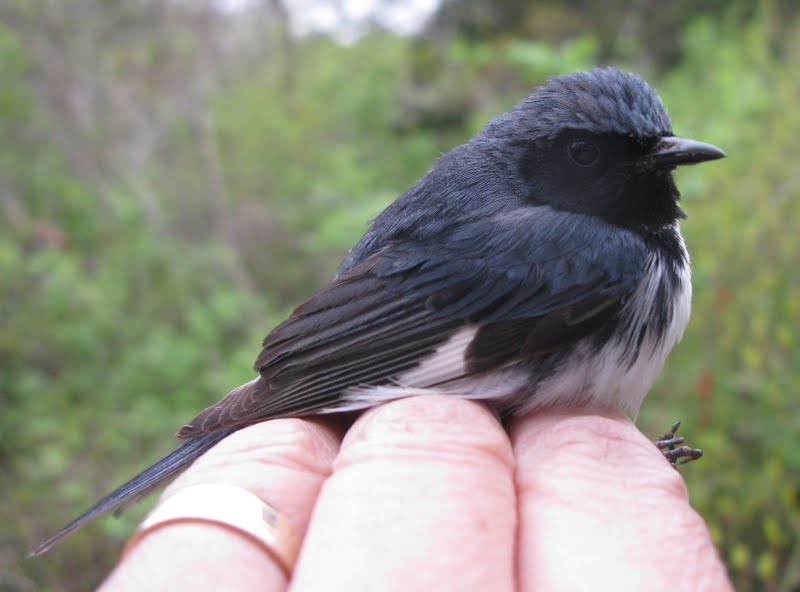
Some nice migrants came in on the 14th even with a cold and misty start including a SY Black-throated Blue Warbler.

He had a molt limit in his wing molting all of his greaters coverts including the greater alula, but not the other two.

I continued hearing Black-throated Blues throughout the next week but he was the only one we captured. Black-throated Green Warblers were also heard singing but they completely eluded us. Our second Nashville Warbler showed up this day, a SY male this time. 

We were happy to capture a White-eyed Vireo 

ageing this bird as a SY due to a molt limit in the primary feathers. White-eyed Vireos can do an incomplete molt eccentrically during their first year, which means they can replace some outer primary feathers and inner secondary feathers leaving a block of retained flight feathers in the middle. This bird replaced his outer 5 primaries, you may be able to see the darker shafts on those feathers.

I was finally able to get a picture of a more cooperative Carolina Wren of unknown sex, who wasn't as squirmy as the others. They can have a molt similar to the vireo above, although it was harder to tell on this particular bird, who may have just molted the greater coverts since the flight feathers appear to line up fairly well. The primary coverts were extremely abraded so we aged it as a second year.  

A SY Common Yellowthroat who was first banded as a hatch year bird on 2 Aug 2010 and found with avian pox on his lower mandible showed up this day with it completely healed so his immune system was able to get rid of the virus.

I wasn't able to get out again until the 20th as rain occured every day from May 15th- May 19th. The only new species for the spring season this day was a beautiful ASY male Red-winged Blackbird.  

The south winds the evening before brought in a few more first spring migrants  for the season on the 21st. A male Blackpoll Warbler, not too cooperative, but I was able to get a quick pic showing off his gorgeous plumage.

We captured another Myrtle Warbler, a SY male, this was the latest spring date in the past 11 years of banding on the island for this species when most have gone through by the first week in May. 

Eleven Prairie Warblers (5 new and 6 recaptures) were netted during this period including two on the 21st that had this 'gunk' under the bill which wasn't there when we first recaptured the bird below on the 3rd.  The other prairie was also first recaptured on the 3rd. Must be something they are eating. Juicy bug? 
Although we aren't allowed to band game birds we were still thrilled to get a Northern Bobwhite, a female,  in our net. Females have buffy coloration to their chin, throat, and supercilium (the area above the eye). In males this area is white. Isn't she outstanding? 

And take a look at the beautiful pattern on her back. I bet she is a bird that was released last fall by fifteen year old Nicholas Fiore on October 31st, for a licensed project to help the species populate this habitat.

We recaptured a Pine Warbler, the one that was banded on May 3rd but sadly she presented with cloacal flukes, not seen on the 3rd. She had no brood patch and may have problems trying to mate.

We captured a Red-eyed Vireo, a first spring capture for this species at our site, in past years we've only captured them in the fall.

All in all, 158 species were netted during this time period. Eighty were new birds and 77 were recaptures. Of the recaptures, 31 were returns from previous years including a few oldies: a 6 yr old Song Sparrow, a 7 yr old American Goldfinch and Common Yellowthroat, and a 9 yr old Gray Catbird. Thanks very much to the following people who helped out at some point during these banding days: Cathy Connolly, Arlene Hedlino, Carolyn Kennedy, Gretchen Putonen, and Jessica Rempel. Birds seen, heard, or captured between 9-21 May are shown below.


Total Birds: 158                    Total Species: 55
Total Banded Species: 23      Birds/100 net-hours: 26

Double-crested Cormorant
Black-crowned Night-Heron
Canada Goose
American Black Duck
Mallard
Red-breasted Merganser
Osprey
Peregrine Falcon
Northern Bobwhite 1
Black-bellied Plover
Willet
Laughing Gull
Ring-billed Gull
Herring Gull
Great Black-backed Gull
Mourning Dove
Belted Kingfisher
Downy Woodpecker 1
Yellow-shafted Flicker
Eastern Phoebe
Great Crested Flycatcher
Tree Swallow
Barn Swallow
Blue Jay
American Crow
Black-capped Chickadee 13
Tufted Titmouse 1
Red-breasted Nuthatch
Carolina Wren 2
American Robin 3
Gray Catbird 31
Northern Mockingbird
European Starling
White-eyed Vireo 2
Red-eyed Vireo 1
Nashville Warbler 1
Yellow Warbler 4
Black-throated Blue Warbler 1
Myrtle (Yellow-rumped) Warbler 1
Black-throated Green Warbler
Pine Warbler 1
Prairie Warbler 11
Blackpoll Warbler 1
Ovenbird
Common Yellowthroat 35
Northern Cardinal 4
Eastern Towhee 3
Saltmarsh Sparrow 1
Song Sparrow 16
Red-winged Blackbird 1
Common Grackle
Brown-headed Cowbird
House Finch
American Goldfinch 23
House Sparrow


Tuesday, May 10, 2011

Slow start

26 April - 7 May
The past two weeks have not been agreeable weather wise to be out and about banding birds, especially with nowhere to escape the elements for both personnel and equipment. I made it out on  26 April with winds from the southwest, but the day was overcast and almost misty. The wind picked up so briskly that I had to close early. I heard the first Willets vocalizing over the marsh and saw my first catbird of the season. I had only 6 species this day, almost all returns from previous years and 3 new birds. One of those was a female cowbird, much to my chagrin. I think the clearing of half of Wing Island has certainly encouraged those birds to look kindly on our banding site as a great place to lay their eggs in the nests of other birds. This bird is however, as much as we don't like it,  a native species and is protected by law.

 I captured 3 Song Sparrows

with one being a new bird and two returns from previous years. The older of the two, an ASY (after second year) male, first banded as an adult last year, surprised me as he had a yellowish hue to his legs and feet. Maybe they darken as they get older but I've never noticed it before.

I also took a picture of a SY (second year) Song Sparrow with pink legs that I am used to seeing on this species.

The weather turned around for the weekend, but unfortunately I was out of town so I didn't get to band again until the 2nd of May. I could hear Brant out by the bay as well as a Common Loon, probably a fly over. The Common Yellowthroats were in and I recaptured an adult male first banded as a hatch year in 2005 making him 6 years old. What a beauty he is!

I had a female cardinal

and chickadee both with beginning brood patches, where they lose their belly feathers to incubate eggs, and by 9:30 the wind was howling so again I closed nets up early.

During the night the winds turned from north to southwest  and with them a few new species for the year arrived. I was expecting a small group of students from Provincetown but unfortunately they missed some of the more colorful birds such as Northern Parula,


 Yellow Warbler,  a SY male with a molt limit in the secondaries,

and the return of a 5 year old Prairie Warbler, all captured on the 2nd net run.

The kids were thrilled to see a Song Sparrow, White-throated Sparrow,  Downy Woodpecker,
Gray Catbird

 and a female SY Pine Warbler

I think they had fun releasing the birds and were glad they came.

Friday the 6th was windy again but were able to open some of our nets with success. We had no new species for 2011 except a Carolina Wren who wriggled out of my hands before getting a picture. Saturday was a more successful day with a nice variety of birds. Two significant encounters included a Black-capped Chickadee first banded in 2002 as a hatch year bird making her 9 years old and  a Prairie Warbler we first banded as a SY bird in 2004, and have captured in the same area every year after, making him 8 years old. Gretchen found a bird we rarely get in our nets, this is only the seventh bird in 11 years and 2nd time captured in the spring, a Brown Thrasher.

We aged this bird as ASY due to the similar lustre of the greater coverts, carpal covert, primary coverts, and remiges.

I photographed a dull morph White-throated Sparrow, only the 3rd individual so far this spring. We usually have numerous White-throats that pass through, but I probably missed most of them due to inclement weather.

 A more brilliantly colored individual showed up earlier in the week, a bright morph variety.

We captured 2 male Eastern Towhees, one being an older adult, who was not very cooperative with having his picture taken, but I so wanted to get a pic of that gorgeous red eye

and a much more cooperative SY male

You can see the difference in how they molt, the similar color and lustre of the older adult, who molted all his feathers last year 

and the retained juvenal primary coverts compared to the replaced greater coverts of our SY bird.

As Judith says, Gretchen had good birdy kharma on Saturday finding not only the Brown Thrasher but also an ASY male Nashville Warbler

and an Ovenbird, probably heading over to the Punkhorn Parklands to breed.

Thanks very much to Judith Bruce, Stew Goodwin, Tiffany Kerstan and her boyfriend, Steve, and Gretchen Putonen for helping over the past two weeks. Birds seen, heard, or captured between  26 April- 7 May are shown below.
Total Birds: 108                                Total Species: 49
Total Banded Species: 20                 Birds/100 net-hours: 20


Common Loon
Double-crested Cormorant
Great Blue Heron
Brant
Canada Goose
Turkey Vulture
Osprey
Northern Harrier
Red-tailed Hawk
Greater Yellowlegs
Willet
Laughing Gull
Ring-billed Gull
Herring Gull
Great Black-backed Gull
Mourning Dove
Downy Woodpecker 3
Yellow-shafted Flicker
Eastern Phoebe
Great Crested Flycatcher
Tree Swallow
Blue Jay 2
American Crow
Fish Crow
Black-capped Chickadee 27
Tufted Titmouse
Carolina Wren 1
American Robin 2
Gray Catbird 24
Northern Mockingbird
Brown Thrasher 1
European Starling
Nashville Warbler 1
Northern Parula 2
Yellow Warbler 2
Pine Warbler 1
Prairie Warbler 6
Ovenbird 1
Common Yellowthroat 7
Northern Cardinal 4
Eastern Towhee 2
Song Sparrow 7
White-throated Sparrow 3
Red-winged Blackbird
Common Grackle
Brown-headed Cowbird 1
House Finch
American Goldfinch 11
House Sparrow