Wednesday, September 11, 2013

August

August was quite a bit quieter bird wise compared to previous years. Where are all the Eastern Kingbirds? We banded 22 last summer but haven't had one in our nets this year. We have barely recorded hearing or seeing them too. Comparing the month of August, other bird numbers are down too, the most dramatic being Eastern Phoebe (29-2012 compared to 3-2013) and Gray Catbird (433-2012 compared to 95-2013) . Bird populations fluctuate from year to year, but there was such a change from last year.

We captured our first Saltmarsh Sparrow for 2013 on 3 August, a handsome male.
 
He was definitely breeding, there was no missing his very large CP (cloacal protuberance) on such a little bird. For those of you who are not banders, this area is normally flat but during breeding structures called deferent ducts fill with sperm and produce the protuberance seen below.  We are able to sex this species as male when we visualize the CP.
 
We captured a hatch year (HY) Saltmarsh Sparrow, maybe his offspring, on the 6th.
 
The Saltmarsh Sparrow used to be called Saltmarsh Sharp-tailed Sparrow. You can see why! This picture came from another bird on the 19th, a SY (second year) bird I believe.
 
On 5 August we banded our 5th ever Eastern Wood Peewee, strange considering they breed in numerous areas nearby. They belong to the flycatcher family but differ from phoebes by their orange lower mandible and from Empidonax flycatchers by their very long wing.
 
 We also had our first of 6 Northern Waterthrushes on the 5th
 
as well as a Red-breasted Nuthatch, which we haven't seen or heard on the island since June. 
 
Northern Flickers (Yellow-shafted) are often hard to capture. They are large birds and easily bounce out of the net. This adult male was banded on 12 Aug.
 
Two days later we captured a young male. His moustachial stripe and red head feathers aren't quite as bold.
Before their first prebasic molt another key banders can use to age HY woodpeckers is the comparison of the outermost primary feather (p10-black arrow) to the primary coverts (red arrow). Notice how much longer p10 is compared to the primary coverts. Once this bird molts however p10 will be about the same length.
 
Here we have a teaching opportunity on the 17th probably discussing ageing of catbirds!
 
 
The House Wren banded on the 19th was still in full juvenal plumage.
 
The barring on the wing lines up in a neat row indicating no feathers were molted. House Wrens can do an incomplete molt during their first prebasic molt meaning they can molt their outer primary feathers and inner secondaries. 
 
Our first HY Great Crested Flycatcher was also banded on the 19th.
 
I'm sure this bird was quite successful in getting fed by a parent before fledging!
 
In juvenile Great Crested Flycatchers there is cinnamon edging to the wing feathers. 
 
We held our first banding demonstration of the fall for a group taking the ornithology field school course at Wellfleet Bay Wildlife Sanctuary. They traveled to Wing Island to learn about the banding process. (photo by Ronald Kielb)

I've been so fortunate this year to be joined by multiple young adults from other organizations eager to learn about bird banding. Their enthusiasm has been infectious and it has been such a delight to pass on my knowledge to a younger generation of possible future banders. I wanted to get a picture before they left for college or other jobs. Pictured left to right- Ben Lagasse, a U Mass student who monitored the breeding success of Wood Thrush at the Big Oaks National Wildlife Refuge in south central Indiana for a study on population dynamics run by the Smithsonian Migratory Bird Center this summer. Ben also helped me all last year. Keenan Yakola, a U Mass student and a Coastal Waterbird Monitor for Wellfleet Bay Wildlife Sanctuary; Ronald Kielb, Terrapin Research Coordinator at Wellfleet Bay; Karli Rogers, a Biological Science Technician with the Cape Cod National Seashore; Dominique Biondi, Crew Leader  with Mass Audubon, working at South Beach researching Piping Plovers, American Oystercatchers and Least Terns; Carly Congdon and Yianni Laskaris, both Biological Science Technicians at Monomoy National Wildlife Refuge with the FWS monitoring Piping Plover, American Oystercatcher, and Least Terns. Not shown is Corey Accardo, Research Assistant with the Provincetown Center for Coastal Studies.

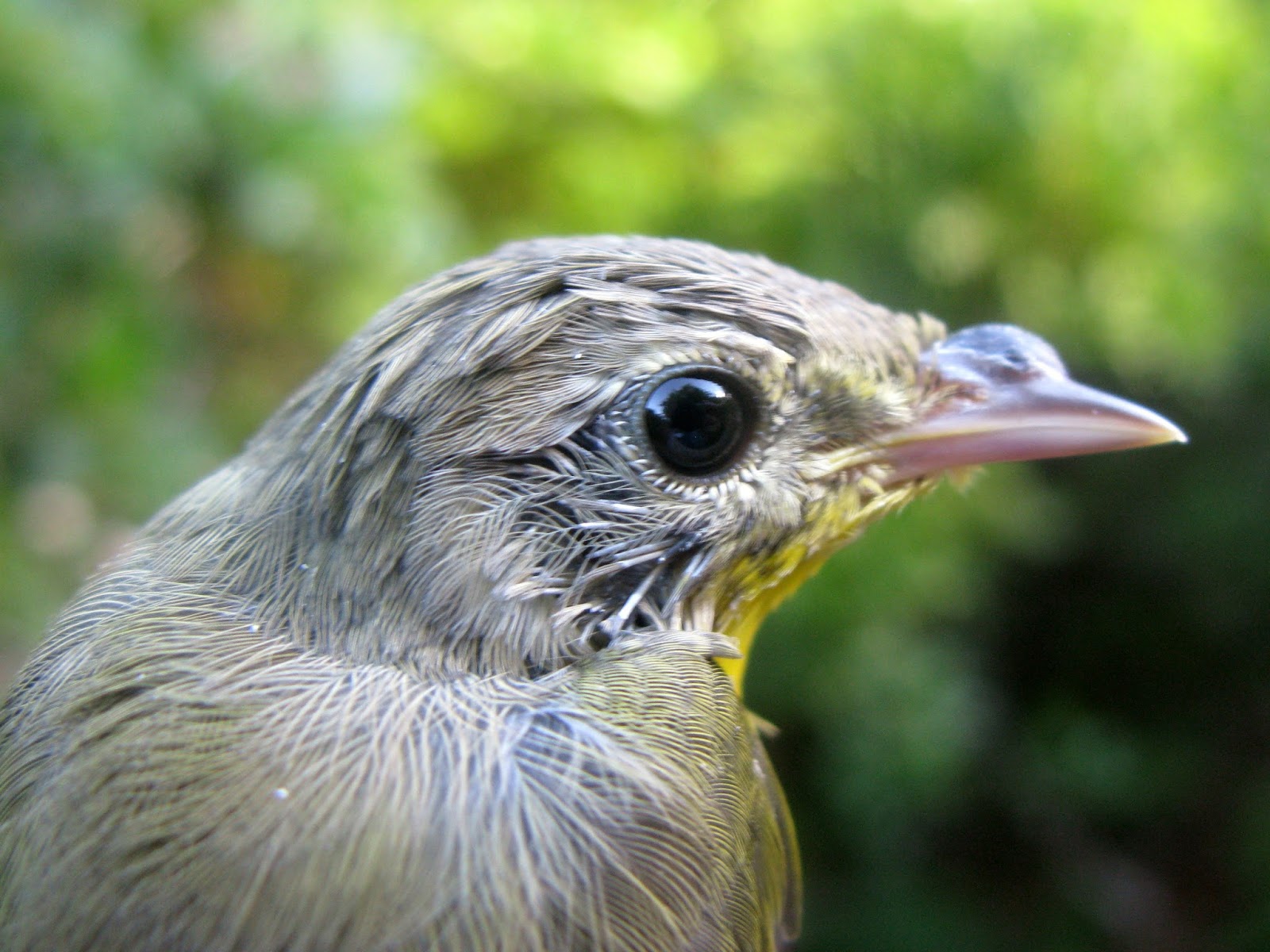
On 26 August we banded a young probable male Common Yellowthroat (very bright yellow throat)

who had 2 leucistic feathers on the wing, the 2nd alula feather (A2) and the outermost primary covert.
 
On the 28th, this Eastern Phoebe must have run into a spider web at some point, you can see it wrapped on the legs. We see this phenomenon occasionally. A few years ago I saw this on a Traill's Flycatcher, except it covered both legs and a Microscopist examined the material and said it was a mixture of spider webbing and plant debris. After publishing this blog, I heard from another bander, Thomas Erdman, Curator at the Richter Museum of Natural History in Wisconsin and this is what he had to say, "Hey, your Phoebe with "spider web" bands, or as we call them "Fairy Rings" is not from spider webbing! We have been documenting this for many years for the autumn migration.. I've given Fairy Rings to spider experts and to Mycologists, they all have said they are not from their domains.  Right now we think it is probably from tree caterpillars like Oak leaf rollers, Bagworms, Sawflies, Cankerworms, etc...  Will have to wait to see if an entomologist can key them out. We've seen Fairy Rings on many species of warblers, and kinglets often have a lot. I had at least two individuals that were severely handicapped by the rings which had also accumulated other debris such as spruce needles! Both were very underweight and probably would have perished had we not cut the "rings" off. The birds apparently can't remove the rings and in some cases the rings continue to add material."
 
So to you banders out there, it is probably a good idea to cut the material off so it doesn't build up. We cut it off the phoebe before releasing.

 
I've banded quite a few hummingbirds this summer compared to previous years, 46 for the month of August. Four of those birds were captured in our mist nets on Wing Island, but the other 42 were banded in my backyard. The busiest day was 9 August when I banded 5 in two hours. Fall migration along the coast isn't as great for hummingbirds as it is further inland so that was a big number for me! My pattern was to band at Wing Island in the morning and then capture hummingbirds in the afternoon near my deck as I'm eating lunch or late in the afternoon. The majority of birds have been young (36). One of the ways we age them is by looking for tiny slash marks on the side of the bill. As the bird gets older the slash marks smooth out. If you double click on the picture you might be able to see what I'm talking about.
 
Females have a white throat with just a bit of greenish spotting.
 
Before the HY males begin to molt, they will have darker green spotting on the throat and no  red gorget feathers.
 
Males have shorter bills and wings than females, but we can also check the outer webbing of the 6th primary feather which is almost non-existent in males as below.

As time passes the males start to develop red gorget feathers, first one

then a few,

then as an adult they have a full gorget. This happens to be a male going through his annual molt, but his feathers appear more orange. The question is will this bird molt again on his wintering grounds and come back with a red gorget? Hopefully I'll catch him again next year! I also had one adult male return that was banded 3 years ago.

I want to thank the following people who helped out with the banding this month (in order of volunteer hours)- Jo-Anna Ghadban, Ben Lagasse, Keenan Yakola, Ronald Kielb, Yianni Laskaris, Carly Congdon, Corey Accardo, Gretchen Putonen, Sheryl and Lauren Johnson, Carolyn Kennedy, Dominique Biondi, Karli Rogers, Kristen Johnson, Judith Bruce, and Ellison Orcutt.
 
The following is a list of birds seen, heard, or banded during the month of August.
 
Total birds: 610                                        Total species: 77
Total species of banded birds: 29             Birds/100 net-hours: 32
 

Common Loon
Double-crested Cormorant
Great Blue Heron
Green Heron
Black-crowned Night-Heron
Canada Goose
American Black Duck
Mallard
Blue-winged Teal
Turkey Vulture
Osprey
Cooper's Hawk
Red-tailed Hawk
American Kestrel
Black-bellied Plover
Semipalmated Plover
Greater Yellowlegs
Willet
Semipalmated Sandpiper
Least Sandpiper
American Woodcock
Laughing Gull
Ring-billed Gull
Herring Gull
Great Black-backed Gull
Roseate Tern
Common Tern
Mourning Dove
Great Horned Owl
Chimney Swift
Ruby-throated Hummingbird 49 new
Belted Kingfisher
Red-bellied Woodpecker
Downy Woodpecker 2 new; 3 recaps
Hairy Woodpecker
Yellow-shafted Flicker 3 new; 1 recap; 1 unbanded
Eastern Wood-Pewee 1 new
Acadian Flycatcher
Willow Flycatcher
Traill's Flycatcher 1 new
Eastern Phoebe 3 new
Great Crested Flycatcher 1 new
Eastern Kingbird 1 new
Tree Swallow
Northern Rough-winged Swallow
Barn Swallow
Blue Jay
American Crow
Fish Crow
Black-capped Chickadee 14 new; 31 recaps; 1 unbanded
Tufted Titmouse 1 new
Red-breasted Nuthatch 1 new
White-breasted Nuthatch
Carolina Wren 10 new; 8 recaps; 1 unbanded
House Wren 2 new
American Robin 14 new; 2 recaps; 4 unbanded
Gray Catbird 95 new; 97 recaps; 9 unbanded
Northern Mockingbird
Cedar Waxwing
European Starling 2 new
Yellow Warbler 13 new; 2 recaps
Pine Warbler
Prairie Warbler 8 new; 2 recaps; 1 unbanded
Ovenbird 4 new; 2 recaps
Northern Waterthrush 6 new
Common Yellowthroat 51 new; 43 recaps; 2 new
Northern Cardinal 4 new; 1 unbanded
Eastern Towhee 6 new; 1 recap; 2 unbanded
Saltmarsh Sparrow 4 new
Song Sparrow 61 new; 46 recaps; 5 unbanded
Red-winged Blackbird 1 new
Common Grackle
Brown-headed Cowbird
Baltimore Oriole 1 new
House Finch 1 new
American Goldfinch 19 new; 3 recaps
House Sparrow 5 new


Friday, August 2, 2013

Birds of Summer

June- July

For those of you interested in the answer to my questions regarding age of the crossbills I banded, I posted a response from Peter Pyle below for both the White-winged Crossbills and the Red Crossbill, which you can view if you go to http://www.capecodbander.blogspot.com/2013/07/crossbills.html.

Our spring migration season ended on 13 June with almost twice as many birds banded as last year. I attribute this to having more help this year enabling us to have all our nets open for the majority of days. We captured our first Cedar Waxing on 4 June, a SY (second year) female.
 
She only had one red waxy tip to her secondaries and her primary coverts were somewhat abraded. 
 
On the June 5th we had a rather late migrating SY female Wilson's Warbler,
 
and Keenan finally got a male Pine Warbler, a bird he was hoping to band this spring. Now if only we could get a Belted Kingfisher for Ron!
 
On the 9th we recaptured a 5 year old Prairie Warbler, she's been captured numerous times since 2010, who has occasionally fooled the bander processing her into thinking she was male. She has a darker than normal face pattern, fairly bold black streaks on her flanks,
 
and quite a bit of chestnut to her back, more like what I would see in a male. 


But she definitely had a brood patch and must just be a female with bolder colored feathers.
 
We also had our 2nd AHY (after hatching year) Traill's Flycatcher on the 9th
 
with a molt limit in the tertials (s8 retained)
 
and had replaced the first 2 inner primary coverts possibly during a pre-alternate molt. 
 
We had the pleasure of  banding a beautiful ASY (after second year) male Baltimore Oriole on 13 June, our last day of spring monitoring. I can't seem to help myself taking pictures of these guys!
 
Thus ended our spring migration monitoring with 431 new birds processed and 780 birds handled. The rest of June and July we only band once/week to monitor our breeding birds.
 
Our first baby bird was captured on 20 June, a Carolina Wren,

followed by a Black-capped Chickadee with a yellow gape and very short bill

 
 and a young Song Sparrow with buffy coloration and yellowish lores on the 22nd.
 
On the 26th our first HY cardinals  and robins were banded. Young cardinals have very brown bills and we can't sex them until they start molting their body plumage. They don't bite quite as hard as the adults either thankfully!
 
Wing Island is a great place to raise young robins, so many berries and bugs.
 
Other birds on 26 June were a beautiful male Tree Swallow
 
but the best bird of the day had to be this Red-tailed Hawk brought to us by Alex Mueller who works at Wild Care, a wildlife rehab facility. They have been caring for this bird when it was having trouble flying but is all better now and ready for release. We agreed to band it to see if it is ever recovered.  They make a cute pair don't they?


A big thank-you to all who helped out this month (in order of volunteer hours)- Ronald Kielb ,Jo-Anna Ghadban, Keenan Yakola, Gretchen Putonen, Carolyn Kennedy, and Alex Mueller.

The following is a list of birds seen, heard, or banded during the month of June.
 
Total birds: 244                                        Total species: 62
Total species of banded birds: 25             Birds/100 net-hours: 22
 
 
Double-crested Cormorant
Snowy Egret
Canada Goose
American Black Duck
Turkey Vulture
Osprey
Red-tailed Hawk 1 NEW
Northern Bobwhite
Black-bellied Plover
Willet
Ruddy Turnstone
Laughing Gull
Ring-billed Gull
Herring Gull
Great Black-backed Gull
Mourning Dove
Great Horned Owl
Ruby-throated Hummingbird 1 NEW
Belted Kingfisher
Downy Woodpecker 1 NEW
Hairy Woodpecker
Yellow-shafted Flicker
Traill's Flycatcher 2 NEW
Eastern Phoebe
Great Crested Flycatcher 1 NEW
Eastern Kingbird
Tree Swallow 1 NEW
Barn Swallow
Blue Jay
American Crow
Fish Crow
Black-capped Chickadee 5 NEW; 10 RECAPS
Tufted Titmouse
Red-breasted Nuthatch
White-breasted Nuthatch
Carolina Wren 4 NEW; 1 RECAP
Eastern Bluebird
American Robin 4 NEW; 1 RECAP
Gray Catbird 37 NEW; 30 RECAPS; 1 UNBANDED
Northern Mockingbird
Brown Thrasher
Cedar Waxwing 3 NEW
European Starling
Red-eyed Vireo 2 NEW
Yellow Warbler 3 NEW; 3 RECAPS
Pine Warbler 1 NEW; 1 RECAP; 1 UNBANDED
Prairie Warbler 7 RECAPS
Blackpoll Warbler
American Redstart 1 NEW
Common Yellowthroat 15 NEW; 48 RECAPS; 1 UNBANDED
Wilson's Warbler 1 NEW
Northern Cardinal 5 NEW; 1 RECAP; 1 UNBANDED
Eastern Towhee 1 NEW
Field Sparrow
Saltmarsh Sparrow
Song Sparrow 6 NEW; 9 RECAPS
Red-winged Blackbird 1 NEW
Common Grackle
Brown-headed Cowbird 2 NEW; 1 RECAP
Baltimore Oriole 3 NEW
American Goldfinch 15 NEW; 12 RECAPS
House Sparrow
 
We banded 5 days in July. We start very early and have our nets open by 5:20 am typically only banding about 4 hours due to heat. We were delighted to capture a young female Red-bellied Woodpecker, our first since 2009.
 
The bills of  young cardinals are starting to turn orange.
 
On July 13th we had our first young male Baltimore Oriole. We differentiate the males from females by their long wings and orange-edged lesser and median coverts.
 
We hadn't heard or seen many Tufted Titmice, they must have been busy with tending young, but we did band our first HY on the 13th too. This young bird still had a yellow gape and lime-colored eye ring.
 
We also had our first Ovenbirds on this day, capturing both a male and female in breeding condition. I imagine they had just finished raising their young, probably in the Punkhorn Parklands, which is only a few miles away. The Punkhorn is approximately 869 acres of wooded town-owned land making it a perfect place for Ovenbirds to breed since they need at least 50 acres of contiguous land. The berries are mostly gone in the Punkhorn by mid summer so many of those birds breeding there come to Wing Island to enjoy the fall berries. 
 
On the 17th we encountered this Brown-headed Cowbird and wondered what Song Sparrow or warbler raised it as its own since the females of this species lay their eggs in the nests of other species.
 
The body plumage was a dull black so we sexed it as male and the under wing coverts were darker.
 
We had a robin on the 25th that at first glance appeared male with her dark head contrasting greatly with her gray back, but she did have a brood patch although she had finished brooding her young.
 
Our first HY Eastern Phoebes also showed up on the 25th, the cinnamon-tipped coverts will be whitish when replaced. They are so cute!
 
We haven't seen or heard too many mockingbirds this summer but did have an adult female with a brood patch on the 31st. We could tell by the condition of her brood patch (whitish and dry) that she had finished brooding her young.
 
We've encountered a great deal of avian pox this summer, mostly in young birds as seen on the upper mandible of this young Common Yellowthroat. Most birds will clear the virus if they have a healthy immune system but if not they can succumb to this disease.

 
Our fall migration monitoring starts on 3 August. Many thanks to the following people who helped out with banding during the month of July- Keenan Yakola, Ron Kielb, Jo-Anna Ghadban, Karli Rogers, Gretchen Putonen, Jen Mook, Yianni Laskaris, Corey Accardo, and Judith Bruce.
 
The following is a list of birds seen, heard, or banded during the month of July.
 
Total birds: 384                                        Total species: 56
Total species of banded birds: 27             Birds/100 net-hours: 65
 

Canada Goose
Osprey
Red-tailed Hawk
Black-bellied Plover
Greater Yellowlegs
Willet
American Woodcock 1 UNBANDED
Laughing Gull
Ring-billed Gull
Herring Gull
Great Black-backed Gull
Roseate Tern
Common Tern
Mourning Dove
Ruby-throated Hummingbird
Belted Kingfisher
Red-bellied Woodpecker
Downy Woodpecker 9 NEW; 3 RECAP
Hairy Woodpecker
Yellow-shafted Flicker
Eastern Phoebe 6 NEW
Great Crested Flycatcher
Eastern Kingbird
Tree Swallow
Barn Swallow
Blue Jay
American Crow
Fish Crow
Black-capped Chickadee 19 NEW; 9 RECAP
Tufted Titmouse
White-breasted Nuthatch
Carolina Wren 10 NEW; 1 RECAP
Eastern Bluebird
American Robin 37 NEW; 1 UNBANDED
Gray Catbird
Northern Mockingbird
Brown Thrasher
Cedar Waxwing 1 NEW
European Starling
Yellow Warbler
Pine Warbler
Prairie Warbler
Ovenbird
Common Yellowthroat 34 NEW; 26 RECAP
Northern Cardinal
Eastern Towhee
Field Sparrow
Saltmarsh Sharp-tailed Sparrow
Song Sparrow
Red-winged Blackbird
Common Grackle
Brown-headed Cowbird 1 NEW
Baltimore Oriole 5 NEW; 1 RECAP
House Finch
American Goldfinch 2 NEW; 1 UNBANDED
House Sparrow 1 NEW


Friday, July 5, 2013

Crossbills

During the winter of 2012-2013 there was an influx of both Red and White-winged Crossbills on Cape Cod. By late spring many birds were still visiting feeders. Keenan Yakola and I decided to see if there was any evidence of breeding in these species by capturing them at feeders.

On the afternoon of  May 20th we visited a home in Wellfleet where the homeowner had been seeing crossbills for many months. He allowed us to set up a net and we captured two White-winged Crossbills, a third Red Crossbill escaped.

I have barely seen these birds in the wild and never banded them before so I have no experience in ageing them. I would appreciate any help from banders with more experience! From what I understand they can breed in all months of the year, providing there are ample food sources, so juveniles can be present all year. My first thought was that the bird below on the right may be an juvenile female due to the mostly brown, streaked plumage with just a touch of a yellow wash. (Click on any photo for a closer view).


However, the wing feathers appeared uniform and fresh and seemed more like adult feathers, leading me to think ASY, but there was no greenish, yellowish, or reddish edging to the primary coverts as the literature suggests. I saw no molt limits in the greater coverts. On the other hand the white tips to the greater coverts were no where near as distinct as the male (directly below), but maybe this is sex related or is this bird a juvenile who has not yet molted into formative plumage?
 
The male had a visible molt limit in the secondaries having retained ss4-7, but since molt limits can occur in AHY/ASYs I'm not sure if this bird is a SY or ASY. The replaced flight feathers appear to have no reddish edging. 
 
 
We saw no evidence of breeding in either bird and neither bird had any fat to speak of.
 
I heard back from Peter Pyle after posting this blog and here is his response about ageing these birds:
 
"These are the most-complex and  least-understood passerines for molt/ageing in NA.

The female WWCR seems to have molt limits in the tertials, but what this means - I don't know. Agree the rest of the wing and tail feathers look like they have been replaced - note the cline toward
fresher primaries from inner to outer, indicating a molt. If so it's an ASY, which is what I think it is, despite the brown plumage (no carotenoids in the diet around during last molt?)

The male WWCR I'd call an SY or TY. I think the s4-s7 are juvenal (as is p10?). So in a normal species I'd say TY but this could also be an SY from early last year that has already undergone most of it's molt and has suspended or arrested. In Part 2 I have code "S-TY" which is what I'd call it, but I don't know what Id' put to the BBL (AHY?). "

We tried again for crossbills on May 25th, this time at a feeder in Eastham where Red Crossbills had been seen most of the winter going to a rather large thistle feeder. We set up our net in late afternoon having banded on Wing Island in the morning. 
 
Keenan has amazing hearing and could hear the crossbills making their way towards our direction. Our waiting paid off as they came to the feeder. Unfortunately we only captured one bird, but he was a beauty!


 Again I'm having difficulty assigning the proper age code to him. His secondaries are retained and the first 2 primaries replaced. I know he isn't a HY and most likely not a SY due to the corresponding pcov replacement, so I guess I will have to go with ASY as they can have molt limits too and not age him a TY, since according to Pyle only 6% can be safely identified as such. Any comments are greatly appreciated.
 
Again Peter Pyle's response:
I'd be comfortable calling the RECR an ASY. It has begun the next molt with p1-p2 and the tertials and then suspended it. You can also  see clines in the older primaries, and the (old) red body plumage is  good for ASY.


Keenan is checking out the trees for any more crossbills.

This bird did not present with any evidence of breeding but was bulging with fat. As I expected a few days later they were no longer seen at the feeder. Off to greener pastures!