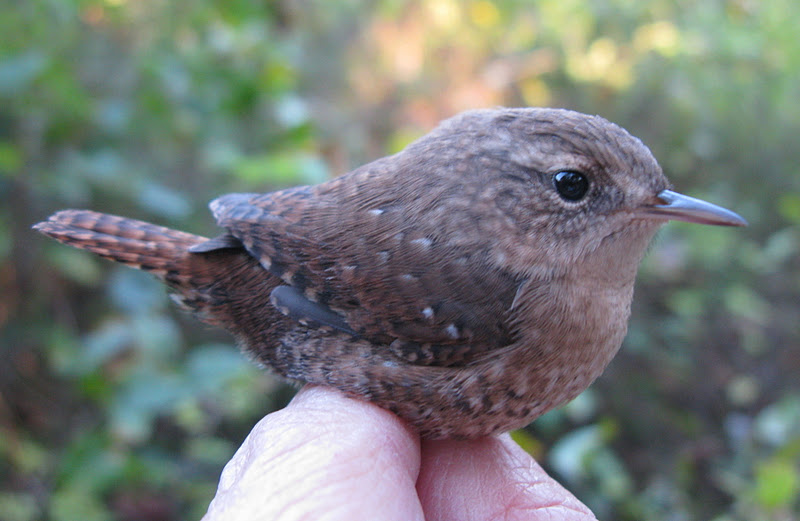
I've been unable to post as often as I would have liked due to taking care of an elderly parent, so I'm posting the last 3 weeks of September here. I'll break it up week by week just as I would if I was posting separately. Our best week was the last week of September when we had many species (39). Rain occured most of the first week and I missed out on most of the second week due to moving my mom out of her apartment and into an assisted living facility.
9-11 September
The second week of September was still rather quiet for this time of year migrant-wise. A meager 22 birds were handled on the 9th, but the highlight of the day were two Yellow-bellied Flycatchers.
A SY Song Sparrow was recaptured that still had a brood patch. She hadn’t yet begun to molt and her feathers were so worn she appeared to have abnormal black feathers when in reality it was the wear that gave the odd appearance. The pictures I took didn't demonstrate this well but you get the idea.
Another HY Song Sparrow was replacing half of it’s tail, giving a good example of the difference between thinner and more pointed outer tail feather compared to the rounder outer adult tail feather on the right.
Finally our numbers increased substantially on the 10th capturing 88 birds, one being a HY Eastern Phoebe that had finished it’s first prebasic molt,
replacing the inner greater coverts, but retained the outer two smaller, buff-edged outer greater coverts.
This HY male American Redstart had more yellow streaking on his breast than I’ve seen before.
Our first Western Palm Warbler, with it’s shorter tail, beige supercilium and breast came in on the 10th too.
The highlight of the day was a Mourning Warbler.
On Sunday 11 September a banding demonstration was held for the public. Approximately 41 people attended. We handled 65 birds of 17 species of birds including Yellow-breasted Chat, always an impressive bird, Baltimore Orioles, Ovenbird, Prairie Warbler,
Hairy and Downy Woodpecker, Red-eyed Vireo, chickadees and titmice, goldfinches, Common Yellowthroats, Eastern Towhee, Carolina Wren, House Finch, Song Sparrow, of course MANY Gray Catbirds, and our earliest ever Brown Creeper!
One of the Gray Catbirds recaptured this day turned out to be originally banded as an After Second Year from the Punkhorn in 2009 during one of our MAPS banding days, making it at least 4 years old . We've recaptured numerous birds on Wing Island originally banded in the Punkhorn.
Julie O'Neil who works at the museum, took this picture of our 'band' of merry men (or should I say women!). Pictured left to right- Jessica Remple, Gretchen Putonen, Sue Finnegan, Carolyn Kennedy, Judy Keller, and Judith Bruce. Another one of our 'regulars' Jo-Anna Ghadban couldn't make it.
Many thanks to those above for helping this week, also Judy Fenwick.
The following is a list of birds seen, heard, or captured (with numbers) this week.
Total birds: 176 Total species: 50
Total banded species: 24 Birds/100 net-hrs: 50
Common Loon
Great Blue Heron
Canada Goose
American Black Duck
Osprey
Cooper's Hawk
Merlin
Least Sandpiper
Ring-billed Gull
Herring Gull
Great Black-backed Gull
Mourning Dove
Great Horned Owl
Belted Kingfisher
Red-bellied Woodpecker
Downy Woodpecker- 3
Hairy Woodpecker- 3
Yellow-shafted Flicker
Yellow-bellied Flycatcher- 2
Eastern Phoebe- 1
Tree Swallow
Barn Swallow
Blue Jay
American Crow
Fish Crow
Black-capped Chickadee- 11
Tufted Titmouse- 6
White-breasted Nuthatch
Brown Creeper- 1
Carolina Wren- 6
House Wren
American Robin
Gray Catbird- 88
Cedar Waxwing
European Starling
Red-eyed Vireo- 6
Prairie Warbler- 1
Western Palm Warbler- 1
American Redstart- 1
Ovenbird- 1
Mourning Warbler- 1
Common Yellowthroat- 12
Yellow-breasted Chat- 2
Northern Cardinal- 1
Eastern Towhee- 2
Song Sparrow- 12
Baltimore Oriole- 2
House Finch- 1
American Goldfinch- 11
House Sparrow- 1
17-21 September
We got out 5 days this week. Two more Warbling Vireos were banded on the 17th
another Mourning Warbler (19th),
and we had our first Black-and-white Warbler of the fall grace us with her presence on the 17th. She was a HY with a pale buffy face
and a molt limit in the alula feathers. Her second alula feather showed only a trace of white edging, which would show white on both sides of the feather in an adult.
Our first Wilson’s Warbler came in on the 20th,
a first year male sporting an extensive black cap but with green edging indicative of first year birds.
We also captured a female adult Eastern Towhee with her brilliant red eye.
Compare it to a brown-eyed first year towhee. By the spring her eye will be red too.
Another first of the fall season for us was a Lincoln’s Sparrow on the 21st with it’s delicate streaking on both the breast and throat.
I certainly was expecting more in the way of migrants this week adding only 3 new species since the week before. It could be the northeast winds at the beginning of the week pushed the migrants further inland and few migrants come through on south winds we experienced at the end of the week. The last of the Ruby-throated Hummingbirds was captured on the 19th and I don’t expect to band anymore on Wing Island this year. Capture rates of all species were low too for this time of year with an average of 33 birds per 100 net-hours.
Thanks to all who helped with the banding sessions during the five days: Jo-Anna Ghadban, Gretchen Putonen, Carolyn Kennedy, Arthur Driscoll, and Mike Quinlan, a visiting bander from Maryland.
The following is a list of birds seen, heard, or captured (with numbers) this week.
Total birds: 213 Total species: 52
Total banded species: 24 Birds/100 net-hrs: 33
Great Blue Heron
Canada Goose
Turkey Vulture
Osprey
Sharp-shinned Hawk
Cooper's Hawk
Black-bellied Plover
Greater Yellowlegs
Herring Gull
Great Black-backed Gull
Mourning Dove
Black-billed Cuckoo
Ruby-throated Hummingbird-2
Belted Kingfisher
Red-bellied Woodpecker
Downy Woodpecker- 2
Hairy Woodpecker
Yellow-shafted Flicker
Eastern Phoebe- 1
Tree Swallow
Barn Swallow
Blue Jay
American Crow
Fish Crow
Black-capped Chickadee- 21
Tufted Titmouse- 11
White-breasted Nuthatch
Carolina Wren- 8
House Wren- 3
American Robin- 1
Gray Catbird- 105
Cedar Waxwing
European Starling
Warbling Vireo- 2
Red-eyed Vireo- 5
Pine Warbler
Western Palm Warbler- 1
Blackpoll Warbler- 11
Black-and-white Warbler- 1
American Redstart- 1
Mourning Warbler- 1
Common Yellowthroat- 6
Wilson's Warbler- 1
Yellow-breasted Chat-2
Northern Cardinal
Eastern Towhee-11
Song Sparrow-7
Lincoln's Sparrow-1
Swamp Sparrow-4
Red-winged Blackbird
American Goldfinch-5
House Sparrow
25-28 September
Finally! The nets were hopping this week. We had a nice variety of birds with northwest winds most of the days pushing migrants through our area. Rainy days prevailed between the 22nd -24th and I fully anticipated getting skunked on the 25th too and had cancelled banding the night before, but was pleasantly surprised when the rain had blown out and we could get out. The best day for numbers was on the 25th with 105 birds captured, but we had the most species variety on the 26th – 26 banded species for the day.
On the 25th we captured all three of those confusing fall warblers often mistaken for one another; Bay-breasted,
with grayish legs and a hint of rust coloration on the flanks,
a HY male Pine Warbler
with its unstreaked back,
and numerous Blackpoll Warblers, a HY male shown here with black feathering on his face, throat, and breast.
Our first Myrtle Warblers came in this day too (3 of the hundreds I anticipate will show up in our nets this year), all first year birds.
Blackpoll Warblers appear to be having a good year. By the end of this week we had already banded 38 birds and expect to band more in October. Our average number of Blackpolls over the past 10 years is only 18 birds/year so I’ll be curious to see how many we actually get when our season is over. Another regular in our nets this fall are Yellow-breasted Chats with 10 banded birds so far.
An additional first for fall on the 25th were 2 White-throated Sparrows.
What a great day the 26th was! We had a foggy start but that soon burned off and the day turned out to be lovely. It proved to be a good migration day. It was a hard call to pick our best bird of the day. Was it the Blue-headed Vireo with his beautiful plumage and white spectacles?
Or maybe it’s cousin, the more subdued Philadelphia Vireo, a species we don’t band that often?
Notice the almost non-existent last primary feather (p10) on the outer edge of the primary coverts, a good key to differentiate it from a Warbling Vireo. Occasionally we get very bright Warbling Vireos and dull Philis.
But then again the best bird could have been the Gray-cheeked Thrush!
Although for me I think I’ll give it to the Yellow-billed Cuckoo, only the 3rd one we’ve ever banded at this site, a handsome HY bird growing in new tail feathers.
We had many nice birds this day but those that had their pictures taken included our first of the season Indigo Bunting, a HY female with just a hint of greenish-blue color in her wing,
a HY male Nashville Warbler,
our first of fall HY Magnolia Warbler
and another young male Wilson’s Warbler.
On the 27th we banded a young female Wilson’s Warbler, lacking a black cap,
a HY female Northern Parula,
and a Swainson’s Thrush with its buffy eye ring compared to the Gray-cheeked from the previous day.
We had two unfortunate young birds with pox on their mandibles causing deformities. A Gray Catbird missing part of it’s lower mandible on the 26th,
and a male Common Yellowthroat missing part of it’s upper mandible.
Numbers of birds lessened a bit on the 28th, but we did capture another Black-and-white Warbler, Yellow Palm Warbler, more Myrtles and Blackpolls and our 3rd Mourning Warbler, a HY male.
Thanks to Jo-Anna Ghadban and Gretchen Putonen for helping this week. Due to a weekend getaway I won’t be able to get out into the field again until October 3rd provided the rain holds off.
Total birds: 344 Total species: 63
Total banded species: 39 Birds/100 net-hrs: 54
Great Blue Heron
Canada Goose
Mallard
Black-bellied Plover
Greater Yellowlegs
Herring Gull
Great Black-backed Gull
Mourning Dove
Yellow-billed Cuckoo- 1
Ruby-throated Hummingbird
Belted Kingfisher
Red-bellied Woodpecker
Downy Woodpecker- 2
Hairy Woodpecker- 1
Yellow-shafted Flicker
Eastern Phoebe- 4
Tree Swallow
Blue Jay- 2
American Crow
Fish Crow
Black-capped Chickadee- 19
Tufted Titmouse- 11
White-breasted Nuthatch
Carolina Wren- 5
House Wren- 2
Eastern Bluebird
Gray-cheeked Thrush- 1
Swainson's Thrush- 1
American Robin
Gray Catbird- 141
Cedar Waxwing
European Starling
Blue-headed Vireo- 1
Philadelphia Vireo- 1
Red-eyed Vireo- 20
Nashville Warbler- 1
Northern Parula- 1
Magnolia Warbler- 2
Myrtle (Yellow-rumped) Warbler- 17
Black-throated Green Warbler
Pine Warbler- 3
Prairie Warbler
Western Palm Warbler- 2
Yellow Palm Warbler-3
Bay-breasted Warbler- 1
Blackpoll Warbler- 29
Black-and-white Warbler- 1
American Redstart- 1
Ovenbird- 1
Mourning Warbler- 1
Common Yellowthroat- 7
Wilson's Warbler- 3
Yellow-breasted Chat 3
Northern Cardinal- 1
Indigo Bunting- 1
Eastern Towhee- 6
Song Sparrow- 26
Lincoln's Sparrow- 4
Swamp Sparrow- 9
White-throated Sparrow- 4
Common Grackle
American Goldfinch- 5
House Sparrow