Wednesday, May 9, 2012

Late March-30 April

We had a mild winter on Cape Cod this year with temps warm enough that I could have banded throughout the winter. I had no nets set up at my yard feeders so I was chomping at the bit by March. We did have numerous turkeys visiting our yard in March and it was fun being so close to displaying males. The pictures aren't the best as they were taken through a window.


Many people put their feeders out in March with reports of early migrating Ruby-throated Hummingbirds. I had a call from a person in Dennis who had a hummingbird at her feeder the day after she put hers out. She recognized it as a Selasphorus since I had banded a Rufous Hummingbird at her house in 2007. I went over the next day (25 March) and it turned out she had an Allen's Hummingbird, which I believe is our 4th state record. This After Hatching Year male had an all green back,
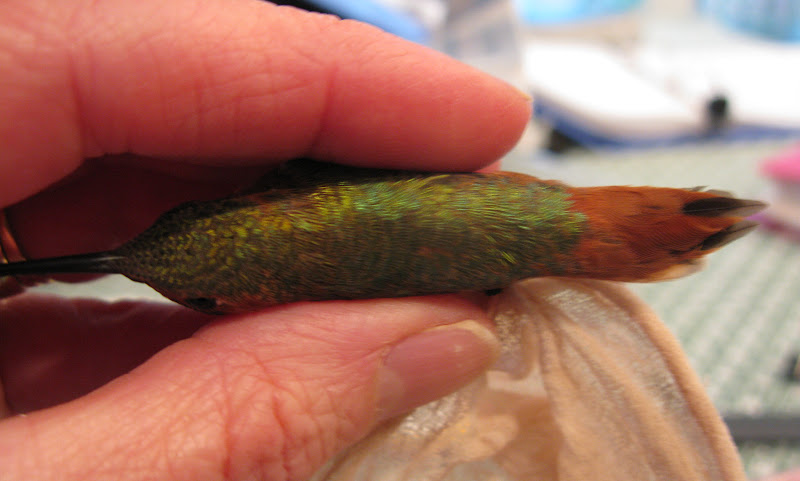
a lancelot shaped r2 and very thin r5 measuring 1.2mm,

and a very beautiful orange colored gorget.

Our first official banding day on Wing Island was 13 April. We still had two nets to install with others needing to be reset so we opened on the later side and couldn't open all of our nets. We captured two American Goldfinches together, a probable pair, both SY (second year) birds. The male was halfway finishing up his prealternate molt into breeding plumage.

We also banded our first of numerous Swamp Sparrows

and five birds returned to us from previous years including a 5 year old Song Sparrow

and a SY Carolina Wren of unknown sex.

The next day we recaptured a Hermit Thrush first banded last year

as a HY (hatch year) bird. The teardrop buffy edging to the coverts indicate a SY bird.

Our first White-throated Sparrows graced the nets and could be heard singing all around the island. White-throats are just moving through at this time as they head further north to breed.

The 16th proved to be our best day with 52 birds handled including our first ever Brown Creeper in the spring.

A handsome ASY (after second year) Gray Catbird was captured, the first of many! We didn't capture another one until May.

Young Northern Cardinals can go through a complete molt as adults do so in the spring unless we see a molt limit, birds are aged as AHY (after hatch year). We captured a female cardinal and were able

to age her as a SY due to retained juvenal tertials (s8 and 9), those two brownish flight feathers closest to my thumb.

Warblers this day include yellow-rumps, or Myrtle Warblers, one of our earliest warblers to migrate north. Many yellow-rumps spend the winter on cape. Pictured below is an ASY male.

Yellow Palm Warblers were passing through too, banding six new birds.

Pyle says that most Palm Warblers cannot be sexed by plumage alone except for possibly the length of the crown patch, but more study is needed. In this case the crown patch measured 21mm, on the highest end for an older adult male. We will send his sex in the BBL as unknown with a note that we suspect male. 

Other birds gracing our nets were an unwelcomed guest, a male House Sparrow, although if he didn't have such a bad reputation we would consider him quite handsome!

After our 'big' day on the 16th, numbers of birds plummeted to 20 or less per day, numbers more consistent with April. Additional unwelcomed guests were found on the 17th, male (first below) and female (second below)Brown-headed Cowbirds.


Cowbirds can have a complete molt as a first year bird so we typically age them as AHY (after hatch year) at this time of year. The male appeared to have a retained juvenal greater covert (the brownish feather among the other black coverts) so we aged him as SY.  

We can also look to see if there is a molt limit in the underwing coverts. We found more brown juvenal feathers among one of the feather tracts (above the middle of my thumbnail).

Eastern Towhees arrived on the 20th, both SY males. The male below appeared to have a lack of melanin showing a washed out appearance.

They were aged SY by a molt limit in the wings, retained primary coverts and replaced greater coverts.

Although we've heard them singing all around us, we didn't capture a Pine Warbler until this day a SY female.

The most interesting bird on the 20th was a Savannah Sparrow.
  
Reading about molt in Pyle, Savannah Sparrows have a partial molt in their first year, replacing all median and greater coverts, 1-3 tertials (secondaries 7-9) in most birds, and no rectrices (tail feathers). The photo below shows juvenal rects with a growth bar. As far as the tertials go, the bird replaced s8 and 9 on  the right wing, but only s9 on the left wing all pointing to a SY bird.
  
But on examination of the whole wing, it appeared this bird had replaced some inner primary coverts which were much wider, darker, edged in buff while the retained pcovs were very abraded, lighter and lacked edging. The same pattern appeared in both wings. It was hard to get a great picture of this as lighting wasn't very good. Some of the primaries/secondaries looked replaced too. Some birds just leave me stumped!

Thanks very much to those who helped out this month- Jo-Anna Ghadban,  Jessica Rempel, Alice Wynne, and Judith Bruce.
The following is a list of birds seen, heard, or captured (with numbers) during April.

Total birds: 166                                           Total species: 58
Total banded species: 20                             Birds/100 net-hrs: 23

Great Blue Heron
Brant
Canada Goose
American Black Duck
Mallard
Common Eider
Turkey Vulture
Osprey
Red-tailed Hawk
Northern Bobwhite
Killdeer
Greater Yellowlegs
Solitary Sandpiper
Willet
Laughing Gull
Ring-billed Gull
Herring Gull
Great Black-backed Gull
Mourning Dove-1
Great Horned Owl
Mourning Dove
Belted Kingfisher
Red-bellied Woodpecker
Downy Woodpecker-2
Hairy Woodpecker
Yellow-shafted Flicker
Eastern Phoebe
Tree Swallow
Blue Jay
American Crow
Fish Crow
Black-capped Chickadee-40
Tufted Titmouse-7
Brown Creeper-1
Carolina Wren-9
Golden-crowned Kinglet
Eastern Bluebird
Hermit Thrush-6
American Robin
Gray Catbird-1
European Starling
Yellow Warbler
Yellow-rumped (Myrtle) Warbler-5
Pine Warbler-2
Yellow Palm Warbler-6
Northern Cardinal-11
Eastern Towhee-2
Chipping Sparrow
Savannah Sparrow-1
Song Sparrow-30
Swamp Sparrow-4
White-throated Sparrow-14
Red-winged Blackbird
Common Grackle
Brown-headed Cowbird-7
House Finch
American Goldfinch-13
House Sparrow-4


Tuesday, January 3, 2012

November/End of 2011

I am very late at posting our last month of banding, but better late than never. With the mild fall weather we were able to band nine days in November with our last day on the 26th. Our first Fox Sparrow came in on the 1st. Some years we miss this species especially if bad weather forces us to shut down early. We banded 3 of them, all HY's.


We were quite surprised to find a Baltimore Oriole in our nets on the 2nd, this is the latest date ever for our site, she stayed around for a few days.

We aged her HY, the molt limit visible in her greater coverts with her 3 inner coverts replaced.

We didn't get out in the field again until the 6th and captured our 3rd Yellow-shafted Flicker for the year.

We conservatively aged him as ASY, but made notes on the molt limits we observed in the primary coverts. The two inner pcovs appeared to be 2nd generation, the 3 inner pcovs looked juvenal, and the remaining outer pcovs replaced this year.  

We ended our season banding 71 Swamp Sparrows, all in the fall and 99% HY. As I've said before the majority of our Swampies have yellowish lores, but I've heard from other banders in different areas that they don't observe this in their HY birds. I took a photo of two SWSP's with the typical range we see in the lores of our birds, but some are quite yellow. I'd be interested to hear from other banders if they see the same coloring.

and on the 7th

We banded our 2nd Marsh Wren of the year on November 6th.

Another latest record for us was this female HY Eastern Towhee banded on the 13th.

We also captured our 3rd and final House Sparrow, an unknown male on the same day.

Many years we don't band this species, but I was very happy when Jo-Anna brought back our one and only American Tree Sparrow with it's bi-colored bill  from her net run on the 19th.

We banded our remaining two Fox Sparrows also on the 19th, such handsome birds!

A call came in about a possible Rufous Hummingbird so I headed out to Wareham on the 20th to try to entice it into the trap. I typically capture hummingbirds soon after setting up the trap but I waited hours for this one. Little did I know that the homeowner put out another feeder in the front of the house after I set up my trap. Once I was able to convince her that the little one wouldn't starve, she took it down and the bird flew right into the trap.

Her long wing indicated female and while she had some gunk on her bill obscuring my view, it appeared to have some striations beyond the base (indicating HY) but at least 70% of the bill was smooth. Allen's Hummingbird was ruled out because of the wide outer tail feather and shape of the 2nd tail feather. She was missing both central rectrices.

Her orange gorget feathers centered around the midline of the throat.

After all the measurements were taken, the homeowner was delighted to release her.

I know she came back after banding, but I haven't heard if and when she finally left.

Our last day of banding on the island was the 26th. A slow day with only 22 birds, seven of those were Myrtle Warblers  making this year's total 501. They sure were late this year!

We also handled 3 recap Black-capped Chickadees, one was first banded in 2008,

another HY Hermit Thrush bringing our year total to 18, our highest number ever, 

White-throated Sparrows (below), a Carolina Wren, and 4 Song Sparrows.

We celebrated our last day with homemade goodies and  Mimosas when we finished banding. A very enjoyable day! Many thanks to all who helped out in November; Jo-Anna Ghadban, Gretchen Putonen, Becca Miller, Judith Bruce, Carolyn Kennedy, Juliet Lamb, and her boyfriend, Yvan.
  
All in all, we had a total of 94 banding days compared with 78 last year. Nets were open for a total of 10,630 net-hours. 4,460 birds were netted giving us an average of 42 birds/100 net-hrs. Birds banded totaled 3,015 individuals.

1311 birds were recaptured during the season. The majority were from 2011, but 200 were birds returning from previous years. Three birds were 9 years old or older; a Blue Jay, Gray Catbird, and Black-capped Chickadee. Five birds were 8 years or older; an American Goldfinch, two Common Yellowthroats, a Prairie Warbler, and Song Sparrow. Two American Goldfinches, three Common Yellowthroats, and two Northern Cardinals were at least 7 years old. Two birds were at least 6 years old; a Slate-colored Junco and a Song Sparrow. We had ten birds at least 5 years old, twenty-three at least 4 years old, and twenty-eight were 3 years old or older. The remaining returns were 1 and 2 year old birds.


93 species were banded this year, the highest total since we began banding in 2000. Of those, two species were new for the station, the Wilson’s Storm-Petrels captured out to sea off Chatham, and a Cooper’s Hawk. Our top ten species for 2011 were: Gray Catbird (628), Myrtle Warbler (501), Song Sparrow (246), Common Yellowthroat (189), Black-capped Chickadee (148), American Goldfinch (95), American Robin (94), Blackpoll Warbler (92), Northern Cardinal (79), and Swamp Sparrow (71).

Ticks were collected from birds for the Cape Cod Cooperative Extension during the 2011 season. 735 ticks were removed from 275 birds of 29 species. Larval ticks will be tested for pathogens including Borrelia burgdorferi, the causal agent of Lyme disease, Babesia microti, the causal agent of human babesiosis and Anaplasma phagocytophilum, the causal agent of human granulocytic anaplasmosis.

The banding program wouldn’t run without the help of our volunteers.  Huge thanks goes to all who helped out this year: Jo-Anna Ghadban (262 hrs), bander Gretchen Putonen (180 hrs), bander Carolyn Kennedy (87 hrs), Judith Bruce (71.8 hrs), Ornithologist Juliet Lamb (58.5), Jessica Rempel (28 hrs), Becca Miller (26 hrs), and Judy Keller (25 hrs). Thanks also go to the following people who helped out at various times this season; Stew & Margo Goodwin, Sheryl, Lauren and Kristen Johnson, Suzanne Faith, Juliet’s boyfriend Yvan, Judy Fenwick, visiting banders Mike Quinlan, James Junta and his assistant Mike, plus a few others that helped out for a day.  A big thank-you to Jan Veneto who made us 150 absolutely beautiful, functional bird bags!

Can't wait for next season!