Tuesday, August 3, 2010

First Fall Migrants

17 - 31 July
Wow, it certainly has been a banner year for numbers of birds and ticks on birds this summer. I've only been able to open a portion of the nets I usually do and have plenty of birds to keep us busy. Ticks removed from birds in the past two weeks numbered close to 300. Although I showed you a tick on a robin in an earlier post, here is a young Carolina Wren with one that is clearly visible below the eye.


On Saturday the 17th, Gretchen, Carolyn, Judy, and I opened 14 nets for 3 hours and captured 54 birds. We had nothing different from the usual suspects, but did capture a first year Brown-headed Cowbird (grrrr....). I wonder what poor warbler species or Song Sparrow ended up raising this bird. As you may know, Brown-headed Cowbirds don't build their own nest but deposit their eggs in the nests of other birds, particularly warblers. The young hatch and are usually much larger, crowding out the smaller nestlings by eating most of the food fed by the parents and may even push out the other birds. They are a native species to this country, originally found for the most part on the Great Plains associating with bison herds. When the European settlers came to this country and proceeded to cut down most of the forests in the east, the cowbird eventually expanded its range wreaking havoc among the birds in our area.
Juvenile Brown-headed Cowbirds look similar to adult females but have buff-edged body and wing covert feathers.

I didn't band at all the following week, instead spent the week with my vacationing husband kayaking, hiking, biking and general fun. The weekend was rainy, so Judith Bruce and Lyndsay Walls assisted me on Monday the 26th. I had another first year male Prairie Warbler  molting into his preformative molt. He had fairly large chestnut back feathers but was molting the feathers on his head so the dark facial pattern was not evident.
He also had a good amount of white in his outer tail feathers.

While young Yellow Warblers that lack red streaking on the breast are not necessarily females, this handsome boy was clearly a male showing off his somewhat indistinct red breast streaks.
Wednesday was a good day with our first fall migrants coming through. We banded three Northern Waterthrush, which is actually not a thrush, but a species of warbler.

First year waterthrushes have rusty tipping to their tertial feathers (the three inner secondary feathers next to my lower two fingers) not present in adults, although the rusty coloration is typically worn off by spring.


On Wednesday a beautiful male Baltimore Oriole who was going through his annual molt flew in.

 
The next day I captured a juvenile male for a good comparison.

He had molted most of his median coverts (larger feathers on the wing with orange and edged in white) and was working on his inner greater coverts (feathers below the med covs). The orange-edged med coverts is a helpful clue that this is a male, females usually have white-edged med coverts shown in the photo below of this young female.


This bird had adventitious molt going on in the right wing, she was replacing her first two primaries, but this was not present in her other wing. It is always important to check both wings in case it might fool you into thinking this was an adult. First year Baltimore Orioles don't have a complete molt their first year. They will retain their primaries, secondaries, primary coverts, and tail feathers replacing them in their second year.

Speaking of adventitious molt, sometimes banders can use this type of molt as a clue to the bird's age seen in this Common Yellowthroat. The pointed tail feathers (rectrices or rects for short) on the right side are juvenile, but has lost some of its left outer rects, replacing them with adult feathers. You can see one of them is clearly more rounded and wider.  

Tail feathers come out rather easily. This is probably a survival mechanism so if a predator grabs a bird by the tail they can "drop" them and escape. I had a young catbird going through the same thing with his tail. You can see the replaced fatter, darker adult rects coming in on the right side of the photo.  
 
More Eastern Phoebes arrived, both adults molting and young birds. This second year bird had a brood patch but was no longer incubating eggs.

We captured numerous young phoebes in the same net area, probably her young. See how much fresher they look!
The "whiskers" on this phoebe's face are known as rictal bristles and are actually hairlike feather projections. They are present in flycatchers and insect-eating birds, thought to protect the face from scaly insects, but we don't really know for sure.


A young European Starling let me have it. Warblers are often docile while I'm taking their picture, but no so with starlings- check it out:
A close up shows the ragged roof of its mouth thought to help grind up those juicy hairy caterpillars they like to consume.


On Friday I was so excited,  YES! I've finally confirmed a species as a breeder on Wing Island, one I have suspected of breeding there but never had positive proof. A Saltmarsh Sparrow!


Their old name, Saltmarsh Sharp-tailed Sparrow came from their very pointed tails.

She had a full brood patch with fluid visible.


We ended the week on Saturday handling a whopping 91 birds, I was happy I had plenty of help. Carolyn came back with a poor juvenile catbird with the worst case of a deformed upper mandible than I have ever seen.

Surprisingly, this bird was obviously able to eat as its weight, although a bit lighter, was comparable with other catbirds at this time of year. I doubt he will make it to next year though.

On a happier note, our first Red-eyed Vireos showed up today. We've never had one earlier than mid August and we've never had Northern Waterthrushes before the end of August. Guess the birds had such a good breeding year they are heading out early.

As adults the red eye is very prominent but hatching year birds have brown eyes, a quick clue to age.

Thanks very much to the following people for helping out at some point during the last two weeks: Judith Bruce, Judy Keller, Carolyn Kennedy, Gretchen Putonen, Jessica Rempel, and Lyndsay Walls. The following birds were seen, heard, or captured during 17-31 July. Numbers reflect captured birds only.
Total birds: 372                        Total species: 52
Total banded species: 23           Birds/100 net-hours: 98

Great Blue Heron
Turkey Vulture
Osprey
Red-tailed Hawk
Northern Bobwhite
Greater Yellowlegs
Willet
Least Sandpiper
Herring Gull
Great Black-backed Gull
Least Tern
Ruby-throated Hummingbird-4
Red-bellied Woodpecker
Downy Woodpecker-7
Hairy Woodpecker
Yellow-shafted Flicker
Eastern Phoebe-8
Great Crested Flycatcher
Eastern Kingbird-4
Tree Swallow
Barn Swallow
Blue Jay
American Crow
Fish Crow
Black-capped Chickadee-37
Tufted Titmouse-11
Red-breasted Nuthatch
White-breasted Nuthatch
Carolina Wren-4
House Wren-1
Eastern Bluebird
American Robin-4
Gray Catbird-153
Northern Mockingbird
Cedar Waxwing
European Starling-1
Red-eyed Vireo-1
Yellow Warbler-17
Prairie Warbler-7
Northern Waterthrush-3
Common Yellowthroat-42
Northern Cardinal-6
Eastern Towhee-2
Saltmarsh Sparrow-1
Song Sparrow-52
Common Grackle
Brown-headed Cowbird-1
Baltimore Oriole-5
House Finch-1
American Goldfinch
House Sparrow

Friday, July 16, 2010

Song Sparrow Extravaganza

Monday 12 July & Thursday 15 July

Monday

Our first of the season HY Common Yellowthroats and Cedar Waxwings showed up on Monday. This juvenile yellowthroat had dark feathering on top of its head and a deep yellow throat. I had to sex it as an unknown, but I find males seem to develop bright yellow throats and females tend to be more subdued. The bird banding lab will only allow us to sex young yellowthroats as male with black feathers emerging in the face.

Juvenile Cedar Waxwings display streaking on the breast that will disappear during the first prebasic molt (preformative molt). I was unable to determine male or female at this time on any of the three waxwings I banded today, although I suspect males due to the width of tipping to the tail feathers.
They all had orange tips to their tails. This indicates they've been feasting on recently introduced honeysuckle bushes. Normally tail tips are bright yellow.

Woodpeckers have a complicated molt strategy but there are numerous clues banders can use to determine young Downy Woodpeckers before their first prebasic molt. One is the elongated outermost primary feather (p10) that extends far below the primary coverts, the small feathers sitting on top of the primaries (outer 10 wing feathers).
Another is the presence of black streaking on the breast.
Lastly, male downys  have red feathering  on top of the head which will move to the rear of the head after its preformative molt. Females don't have red feathers although occasionally a few red feathers could show up.
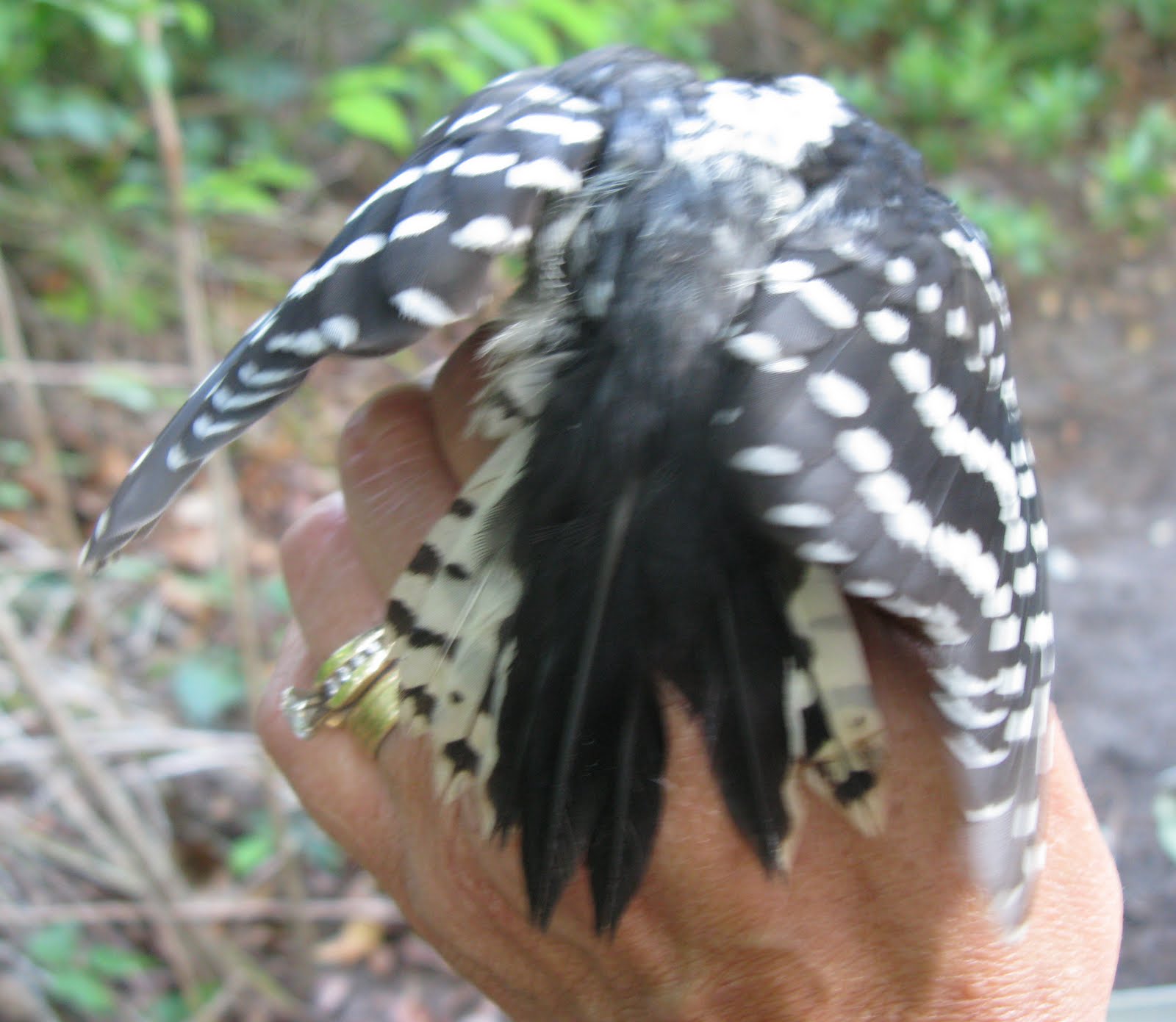
If you are a beginning birder, one way to tell a Downy Woodpeckers from its larger counterpart the Hairy Woodpecker is to try to get a peak at the outer tail feathers. They will have streaks in a Downy (top picture) and no streaks in the Hairy (bottom photo).

I captured another juvenile male cardinal. At some point while his feathers were growing in he experienced extreme nutritional deficiency to a point where he had breaks in the feather vanes on his tail, known as fault bars.
His weight was lower than normal, but he seemed feisty enough and flew off well on release. The only way he would let me get a picture was to let him bite down on my skin. Ouch! Those bills are made for pinching...
Speaking of large bills you would think this House Finch would be eager to bite but they are fairly docile in the hand.
Here is a young Prairie Warbler looking a bit scruffy as he begins his preformative molt and takes on adult body plumage.
The preformative molt of the Yellow Warbler begins before fledging and this was a particularly handsome young individual.


Thursday
This day began by opening two nets near the banding table and all was calm. Jessica and I then made our way out to  the north side of the island and opened the bluff nets. Young Song Sparrows began hitting the nets before we finished opening them. We couldn't even make it to the other nets I had planned on opening because we needed to get back and process the birds in hand. One of the juvenile Song Sparrows had avian pox on its toes, an occasional occurence. I've noted avian pox on birds that I've recaptured a year later with no evidence of pox except scarring. I imagine those birds with compromised immune systems would succumb to the disease. It is not a disease that is transmitted to humans.

We recaptured an adult male Song Sparrow originally banded by me as an adult in 2007. His central tail feathers were in such bad condition only the shafts were left. In some birds, feather wear is an indication of age. Young birds have poorer quality feathers that can deteriorate sooner than adult feathers, so we can sometimes determine a birds age by  feather quality. Not so with Song Sparrows. They spend so much time in the brush that their feathers get worn down more easily than a bird perched in trees.
He didn't look too bad overall though.
Another clue for banders identifying young birds is the presence of growth bars in the tail and wings. Growth bars develop as the feathers grow in and indicates the amount of daytime growth (dark bands) versus nighttime growth (light bands).  They are visible in both the wing and tail of this juvenile Song Sparrow. You can see the bands visible about halfway down through the wing feathers.


They may be a bit more apparent to you in the tail.


I was so happy to band our first Northerm Mockingbird this year, an adult female with a brood patch. She had finished nesting by the condition of her abdomen. Adults have yellowish eyes while juveniles eyes are darker. I've been concerned about the state of mockingbirds in recent years. We used to have large numbers nesting on or near the island and they've all but disappeared. I only banded one last year and none in 2008.

She had a crossed bill, another abnormality we sometimes come across. The deformity wasn't too bad, I've seen worse, and she seemed in good health.

We captured our first HY Eastern Towhee today. They are adorable! This is a young male.


Tick infestation on birds was very high today. Almost half of the birds were carrying deer ticks and one poor Song Sparrow had 50 of them! I was glad to relieve it of its tick burden. I removed 119 ticks overall,  almost half the amount I've pulled off all year.

All in all it was a busy two days. I wonder if this is an early indication of an exceptionally busy fall. We ended up with 30 total Song Sparrows. Twice as many as we've banded the whole month of July in past years. We often see these numbers with catbirds, but not Songs before. Many thanks to Jessica Rempel who helped me on Thursday.

Total birds: 94                                   Total species: 36
Total banded species: 17                    Birds/100 net-hours: 120

Osprey
Greater Yellowlegs
Willet
Laughing Gull
Herring Gull
Great Black-backed Gull
Common Tern
Downy Woodpecker- 2
Yellow-shafted Flicker
Eastern Phoebe-1
Tree Swallow
Barn Swallow
Blue Jay
American Crow
Fish Crow
Black-capped Chickadee-9
Red-breasted Nuthatch
White-breasted Nuthatch
Carolina Wren-1
American Robin-7
Gray Catbird-24
Northern Mockingbird-1
Cedar Waxwing-3
European Starling
Yellow Warbler-5
Prairie Warbler-1
Common Yellowthroat-
Northern Cardinal-3
Eastern Towhee-1
Song Sparrow-30
Red-winged Blackbird
Common Grackle
Baltimore Oriole-1
House Finch-1
American Goldfinch-1

Wednesday, July 7, 2010

Lazy Days of Summer

26 June & 2 July

I returned recently from a wonderful trip to the Grand Tetons in Wyoming. The beauty and expanse of this special placed really moved me and was a perfect place to renew your spirit! Gretchen banded on 26 June while I was away and we banded again on 2 July. She captured 3 new species for the year, one Barn Swallow, an Orchard Oriole, and an Eastern Phoebe. Most of the birds both days were first years and this will be the case for the remainder of summer and fall. The numbers of birds in nets increased dramatically by July 2nd with 95 birds processed. We typically see numbers like this towards the end of July as more birds fledge, not the beginning!


Here is a young Barn Swallow that was banded on the 26th.


We banded 7 more of them on July 2nd. Barn Swallows have rusty colored underparts compared with the bright white undersides of Tree Swallows.


They also have white spots on their tail feathers visible in the  photo below.


Juvenile outer tail feathers are rather short and rounded compared with adults. The adult male (shown below) has longer and more pointed outer tail feathers. Females are similar to males but their outer rectrices (tail feathers) are a bit shorter.     


We captured two Orchard Orioles, one on each banding day. Juveniles of both sexes look similar but we can usually determine sex by the length of their wing. Both orioles banded were females. The picture below shows a female in the spring (SY or second year). Males look quite different and one of these days I hope to capture an adult male in breeding plumage.


We banded our first  hatch year Baltimore Oriole on the 2nd, also a female. 

Other baby birds from the two days include an Eastern Phoebe. Young phoebes have buffy edging to their median and secondary coverts as seen in the photo below. As adults this appears as grayish to whitish.


   Below is a baby robin who will soon replace the spots  on its breast  with rusty orange feathers when it begins its first prebasic molt.
                                   

We captured a very young Prairie Warbler on July 2nd. Occasionally very young birds are hard to identify! These birds are referred to as Local rather than Hatching Year because their feathers are growing in and can't sustain flight. As I mentioned in a previous post, all our young birds are taken right back to where they were found in case they are still dependent on parents.

                                    
We captured a second year (SY) male Common Yellowthroat who was without a full black mask as seen on most adult males (see previous post May-Banding Demonstration). Hopefully he'll develop a full gorgeous mask during his molt this summer.  Don't think he was too happy with being banded either as he was telling me what he thought of the whole process!

I'm not sure how much banding we'll do this summer. If it remains hot and humid as it has been the nets stay closed! Sometimes we can get a few hours in (5-8:30) before it heats up.

Thanks to Gretchen Putonen who manned the station on the Saturday in June while I was away and banded with me on Saturday July 2nd. We also had help from the Johnson family on the 2nd who come every summer, Sheryl and her daughter Lauren. The following birds were seen, heard, or captured.  Numbers reflect captured birds only:

Total birds: 124                            Total species: 37
Total banded species: 19             Birds/100 net-hours: 51

Osprey
Greater Yellowlegs
Willet
Herring Gull
Great Black-backed Gull
Belted Kingfisher
Mourning Dove
Downy Woodpecker-6
Yellow-shafted Flicker
Eastern Phoebe-1
Tree Swallow-1
Barn Swallow-8
Blue Jay
American Crow
Fish Crow
Black-capped Chickadee- 19
Tufted Titmouse- 2
Carolina Wren-3
American Robin-1
Gray Catbird-20
Cedar Waxwing
European Starling
Yellow Warbler-10
Prairie Warbler-2
Ovenbird-1
Common Yellowthroat-13
Northern Cardinal-13
Eastern Towhee
Chipping Sparrow
Song Sparrow-14
Red-winged Blackbird
Common Grackle
Orchard Oriole-2
Baltimore Oriole-1
House Finch-1
American Goldfinch-1
House Sparrow