Wednesday, July 20, 2011

Summer Babes

2-16 July
Numbers of birds in our nets began to rise during the first week in July compared to June and by the 2nd week, newly fledged birds were everywhere!

Our first adult Baltimore Oriole appeared on the 2nd still singing during the banding process! This doesn't happen very often to me, but a male Eastern Towhee did the same thing earlier in the season. The male oriole was indeed a very handsome looking fellow.

For some reason, orioles (maybe other blackbirds too) will pry open their beak if you put your fingers on either side of it. Their muscles are quite strong!

Our first HY (hatch year) baby Prairie Warblers were captured on 2 July, 3 babies in the same net throughout the morning.  If you don't know the species well some young birds can be difficult to identify before molting into their formative feathers. This youngster was halfway there.

Before molting really young Prairies have grayish plumage, but still have white in their tail feathers.  

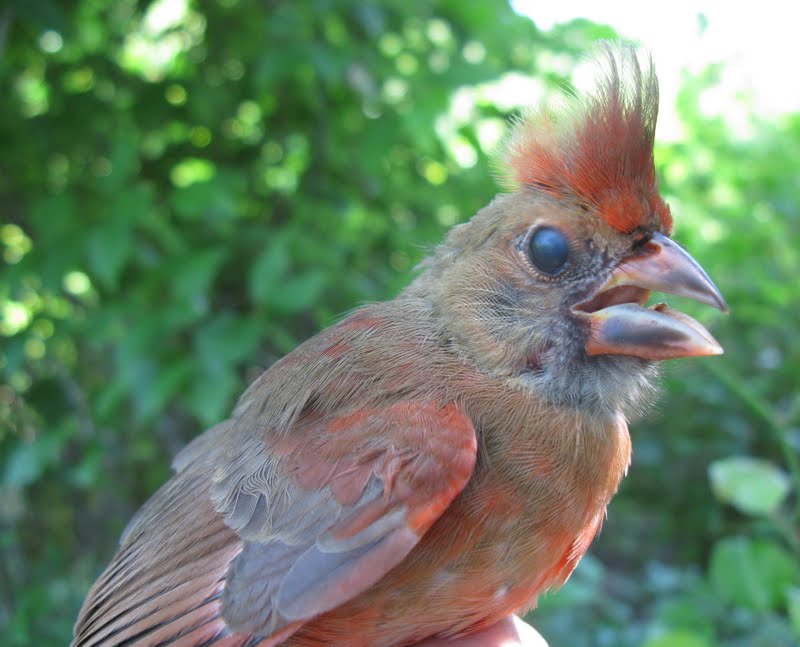
Other young birds this day included a cardinal, still too young to sex.

True to form it did what cardinals do best- here it is coming in for the kill 

And GOTCHA!

It doesn't hurt quite as bad as the adult would!

Our first HY robin showed up on the first round and was still in full juvenal plumage. 

To our delight on 10 July we has our first ever baby Hermit Thrush at Wing Island, still in full juvenal plumage, looking very similar to it's robin cousin above. We've had young Hermits in the past when we ran our MAPS station in the Punkhorn Parklands of Brewster, but previously only had them at Wing Island during the latter half of our fall migration monitoring.


 Back on the 5th we captured an older adult Cedar Waxwing

who probably found a fine female to mate with due to the numerous red waxy tips to his secondaries.

Notice all the streaking to this young female Eastern Towhee, again they look very different from their parents.


Have you ever wondered what a bird's ear looks like? They are quite large, almost the size of the eye in this case. They don't have ear flaps as we do, but have protective feathers covering the opening from turbulent air during flight yet still allows them to hear.  


Other babies on the 5th include our first young female Downy Woodpecker, 

a male Northern Cardinal, further along in its molt compared to the one shown earlier

and both male and female White-breasted Nuthatches. First the male with its very black cap

and the female with a gray cap (she seemed a bit younger and a whole lot cuter!)

Not sure what she was trying to accomplish but she kept biting her own wing!

July 10th brought in a HY Tufted Titmouse posing quite nicely for the camera

and a young female oriole.

A young male was captured on the 16th. His wings were much longer and he was starting to develop some nice orange tips to his coverts.


This is about the time of year that we get young starlings as they flock in groups and today was no exception. I kept my fingers crossed that the group circling above would stay there and not all end up in one of the nets! This is probably the best posed starling I've ever had. Usually their mouths are wide open and are squawking at the top of their lungs.

All in all we handled 208 birds of 20 species, 19 of those on the 16th. We went from handling 28 birds on the 2nd to 88 on the 16th! A big thank you to all who helped out- Gretchen Putonen, Jo-Anna Ghadban, Carolyn Kennedy, Judy Keller, and Jessica Rempel. Birds seen, heard, or captured are shown below.


Total Birds: 208                       Total Species: 40
Total Banded Species: 20         Birds/100 net-hours: 47

Canada Goose
Osprey
Northern Bobwhite
Willet
Herring Gull
Great Black-backed Gull
Mourning Dove
Downy Woodpecker- 9
Yellow-shafted Flicker
Eastern Phoebe
Tree Swallow
Barn Swallow
Blue Jay
American Crow
Fish Crow
Black-capped Chickadee- 22
Tufted Titmouse- 5
White-breasted Nuthatch- 3
Carolina Wren- 10
Eastern Bluebird
Hermit Thrush- 1
American Robin- 12
Gray Catbird- 41
Northern Mockingbird
Cedar Waxwing- 2
European Starling- 1
Yellow Warbler- 2
Pine Warbler
Prairie Warbler- 13
Ovenbird- 2
Common Yellowthroat- 36
Northern Cardinal- 7
Eastern Towhee- 4
Song Sparrow- 26
Red-winged Blackbird
Common Grackle
Baltimore Oriole- 7
House Finch-2
American Goldfinch- 2
House Sparrow


Friday, July 8, 2011

June

As usual, the month of June is very slow birdwise. The majority of migrants have passed through and others are busy nesting. Our last day for monitoring spring migration was 16 June. It proved to be the second worst spring season for us since banding started on Wing Island in 2000. We banded only 260 new birds, compared to a norm of ~ 337. Weather proves to be a challenge on the cape in spring and this year was especially cold, windy, and rainy. I'll be curious to see if our fall will be impacted as well or if the birds will have made up for lost broods. We continue monitoring nets one or two days a week in summer to remove ticks from birds for infection surveillance with the Cape Cod Cooperative Extension.

During the month of June we captured a total of 105 birds; 57 were new. My thoughts were on flycatchers on 3 June and sure enough we caught one, a Traill's Flycatcher, a probable Willow.

Our first Pine Warbler for 2011 was captured on our last net round for the day, a second year female. Her plumage was rather tattered and she had a molt limit in her tail feathers. Pine Warblers generally don't molt their tail as a young bird during their first prebasic molt, so she must have lost some tail feathers adventitiously (accidently) and the new ones replaced come in as adult feathers. She had a brood patch starting and was processed quickly.

A second year male Yellow Warbler but still  brilliantly colored showed up this day.

He had replaced his tertials and secondaries 5,6 during his first prebasic molt.

He even had some chestnut streaking on his crown that I don't often see. According to the Yellow Warbler account in The Birds of North America, the southern forms of this species have variable amounts of streaking on the head.

Our first hatch year birds showed up on 8 June. That is the earliest for us to see hatch years and I was quite surprised considering the cold spring we had. One was a Carolina Wren

and our first baby Song Sparrow.

All our baby birds are quickly processed and brought back to the net area where we captured them.

There were no notable captures again until 26 June when we had our first Great-crested Flycatcher. This bird presented with a non-extensive brood patch and since both sexes incubate the young we were unable to note the sex.

Our first Cedar Waxwings showed up also; a combination of males and females, five in all.

We had one with orange edging to the rectrices where the rest had yellow edging. She was probably munching on a variant honeysuckle species last summer when her tail feathers were growing. Here is a comparision, orange edging on the left, yellow on the right. They weren't too happy being photographed together and it was all we could do to keep the aggressive bird on the right from biting the bird on the left. These second year birds had no red waxy tips to their seconday feathers.

 One of the cutest babies captured on the 26th was our first of the year Barn Swallow!

The lack of extension of the tail feathers compared to adults is easily seen in this photo.


Late in the morning an adult female Ruby-throated Hummingbird showed up, our first one for the season.  
Many thanks to Gretchen Putonen and Judith Bruce for helping out at the banding station during the month of June. Birds seen, heard, or captured are shown below. 

 Total Birds: 105                               Total Species: 52
Total Banded Species: 16                  Birds/100 net-hours: 19

Great Blue Heron
Black-crowned Night-Heron
Canada Goose
Mallard
Osprey
Red-tailed Hawk
Northern Bobwhite
Black-bellied Plover
Willet
Laughing Gull
Ring-billed Gull
Herring Gull
Great Black-backed Gull
Mourning Dove
Yellow-billed Cuckoo
Great Horned Owl
Ruby-throated Hummingbird- 1
Belted Kingfisher
Downy Woodpecker
Hairy Woodpecker
Yellow-shafted Flicker
Traill's Flycatcher- 1
Eastern Phoebe
Great Crested Flycatcher- 1
Tree Swallow
Barn Swallow- 1
Blue Jay
American Crow
Black-capped Chickadee- 3
Tufted Titmouse
White-breasted Nuthatch
Carolina Wren- 4
American Robin- 2
Gray Catbird- 23
Northern Mockingbird
Cedar Waxwing- 5
European Starling
Yellow Warbler- 2
Pine Warbler- 1
Prairie Warbler- 9
Common Yellowthroat- 25
Northern Cardinal- 3
Eastern Towhee
Saltmarsh Sharp-tailed Sparrow
Song Sparrow- 15
Red-winged Blackbird
Common Grackle
Brown-headed Cowbird
Baltimore Oriole
House Finch
American Goldfinch- 9
House Sparrow

Thursday, June 2, 2011

Last Ditch Effort

25-30 May

This week was a last ditch effort to hopefully add a few more migrants for our spring list, but the nets were fairly quiet. Blue-headed Vireos were heard singing near the banding table both on Wednesday and Sunday but none were captured. Wednesday I heard a Black-billed Cuckoo singing from across the marsh. He didn't get captured but we did manage to band an American Redstart, a second year male.

Male redstarts won't resemble the adult until they go through a molt in their second year after breeding. Some black feathers are usually visible by spring and this male has black feathers in the face, throat, and breast.

Redstarts get their name from the reddish orange tail feathers seen on the adult male. Apparently 'start' is an old name for tail. They are often seen flashing their tails as they flit about capturing insects and often do during the banding process too.

They have whiskers called rictal bristles on either side of the bill similar to flycathers, supposedly an aid in capturing insects. You can see them on the left side of his bill.

Another nice bird on Wednesday was a second year male Magnolia Warbler.
Magnolia Warblers go through a prealternate molt during the winter as they get ready for the breeding season, replacing some body and wing feathers. Older adult birds will display 2 generations of feathers in the wing, those that were replaced during their annual molt and those replaced during the prealternate molt. Second year birds will show 3 generations of feathers as was the case with this male. He replaced his inner greater coverts (the shorter feathers with white tips second row down) during the prealternate molt, the remaining outer greater coverts were replaced last fall, and the primary coverts (the smaller browner feathers towards the distal end of the wing) are retained juvenal feathers.

Another Ovenbird showed up too. If you look closely in the lower left corner I unknowingly got part of a beautiful spiderweb in the picture! I'm always amazed at the size of their eyes compared to the head. They prefer to live in large tracts of forest so large eyes would be an advantage in the low light of the woods.

We captured a female Blue Jay with a brood patch. She was first in line to be banded to get her back quickly to her nest.  She posed nicely enabling me to get a quick picture of her. Her blue coloration is not due to blue feathers but something called Tyndall scattering. When light strikes air filled cavities in the feather barbs it produces the blue color we see.

I was able to age her as a second year bird due to the molt limit in her wing. You can see the replaced longer, brighter blue and wider black bars to the inner greater covs compared to the retained outer 3 greater coverts. Also the retained juvenal primary coverts have no barring.

I was able to get out again on Thursday the 26th. Boy did it feel nice to have two sunny days in a row! Felt good for the soul and I think the birds appreciated it too as there was an abundance of bird song. I watched a brilliantly colored male Indigo Bunting in the field at the same time crows were incessantly mobbing a Red-tailed Hawk. The hawk was working the field from north to south perching in a tree near the bay and then would fly to the next tree in a southerly direction. Even the mockingbirds got in on the act of attacking him, but once he moved out of their territory they settled down. I'm a bit surprised they haven't attacked me yet as I'm sure I pass their nest on the way to some of our nets. Mid morning I captured a pair of Eastern Kingbirds, but otherwise no birds of great interest, just the usual suspects. It was great to be able to compare the male and the female kingbird. The plumage is the same for the two sexes, however I did notice an interesting difference in the color of the inconspicuous orange crown feathers. Directly below is the male

whose red crown appeared more brilliantly colored and darker than the female pictured below

The female's wing length was quite short, totally out of  range for a male, plus she had a brood patch. The notch on the outer primary feather (p10) is shorter than the male also. You can see a slight difference in length between the two sexes. First the longer notched p10 of the male

and shorter notch in the female.

The highlight of the day on Sunday was an Eastern Wood Peewee. This was only the 4th peewee we've captured at the station since opening in 2000 and our first spring record. The birds we captured in 2001, 2006, and 2009 were fall birds. At first glance you might think this bird is an Eastern Phoebe, but the lower mandible is a dead giveaway. The lower mandible in the phoebe is black but is orange in the peewee.

Separation from Empidonax flycatchers is easy as the peewee has a much longer wing. The tarsi (leg bones above the feet) are also very short.

As Carolyn was checking nest boxes on the island on Sunday, a female Tree Swallow flew out of the box at the same time one of the white feathers that Tree Swallows use to 'claim' their box fell out. She immediately scooped it up in her bill, looked at Carolyn indignantly and put it right back in the box!

We did get out again on Memorial Day but the activity was so limited we closed nets early and called it a day. We captured only 109 total birds during the four days of banding this week. Of those, 24 birds were returns from previous years and three were at least 7 years old; a cardinal, goldfinch, and Common Yellowthroat, all females. Thanks very much to Gretchen Putonen, Carolyn Kennedy, Judy Keller, Suzanne Faith, and Diane Silverstein for their help this week. Birds seen, heard, or captured between 25-29 May are shown below.

Total Birds: 109                                  Total Species: 50
Total Banded Species: 17                    Birds/100 net-hours: 26

Double-crested Cormorant
Canada Goose
American Black Duck
Osprey
Red-tailed Hawk
Northern Bobwhite
Black-bellied Plover
Willet
Laughing Gull
Ring-billed Gull
Herring Gull
Great Black-backed Gull
Mourning Dove
Black-billed Cuckoo
Belted Kingfisher
Yellow-shafted Flicker- 1
Eastern Wood-Pewee- 1
Eastern Phoebe
Great Crested Flycatcher
Eastern Kingbird- 2
Tree Swallow
Barn Swallow
Blue Jay- 2
American Crow
Fish Crow
Black-capped Chickadee- 13
Tufted Titmouse- 1
Carolina Wren
American Robin
Gray Catbird- 19
Northern Mockingbird
Cedar Waxwing
European Starling
Blue-headed Vireo
Red-eyed Vireo- 1
Yellow Warbler- 3
Magnolia Warbler- 1
Pine Warbler
Prairie Warbler- 2
American Redstart- 1
Ovenbird- 1
Common Yellowthroat- 39
Northern Cardinal- 2
Eastern Towhee
Song Sparrow- 12
Red-winged Blackbird
Common Grackle
Brown-headed Cowbird
American Goldfinch- 8
House Sparrow