I started the month doing some hummingbird banding in my backyard capturing a few hummers. One was a young male who hadn’t started his molt yet. Young males have streaked throats before filling in with red gorget feathers. Notice the buff edged body feathers, a good indicator of age. In the hand you can see grooves on the side of the bill that will gradually wear off with age, but you need a good set of magnifiers to see them!

Another hatch year male captured ten days later was further along in its molt.

The nets during the first two weeks of August have been full of birds. Surprisingly we captured no American Goldfinches, one of the more common birds in our mist nets. They are one of our latest nesters and I assume they are busy sitting on eggs.
On August 2nd we captured 90 birds of 18 species, two of those being our first Great Crested Flycatchers for the year. Both were hatch year birds. They constantly clap their bills together to produce a SNAP type noise and are the largest flycatcher that we handle.

They were beginning to molt in yellow feathers on their undersides.

Cinnamon-edged coloring is present on their rump, wing and tail feathers.

Occasionally during the course of net checking we’ll notice a huge flock of starlings headed for one of our nets. “NO!” we silently pray, hoping they will elude getting caught. Luckily we only caught four hatch years today from a large flock that was visible flying around our meadow nets. It isn’t very often that I capture a picture of a starling NOT in this pose as you’ve seen in previous pictures:

They were in various stages of their first prebasic molt. Their feathers are stunning even if some consider them trash birds due to their non-native status.

Eye color can be a key to sex, with the male being dark brown and a yellow ring surrounds the iris in the female.
 Male
Male Female
Flickers rarely get caught because they are so large and tend to bounce out of a mist net. They are extremely vocal in the hand screeching so loudly they actually hurt our ears! We captured a hatch year male today.
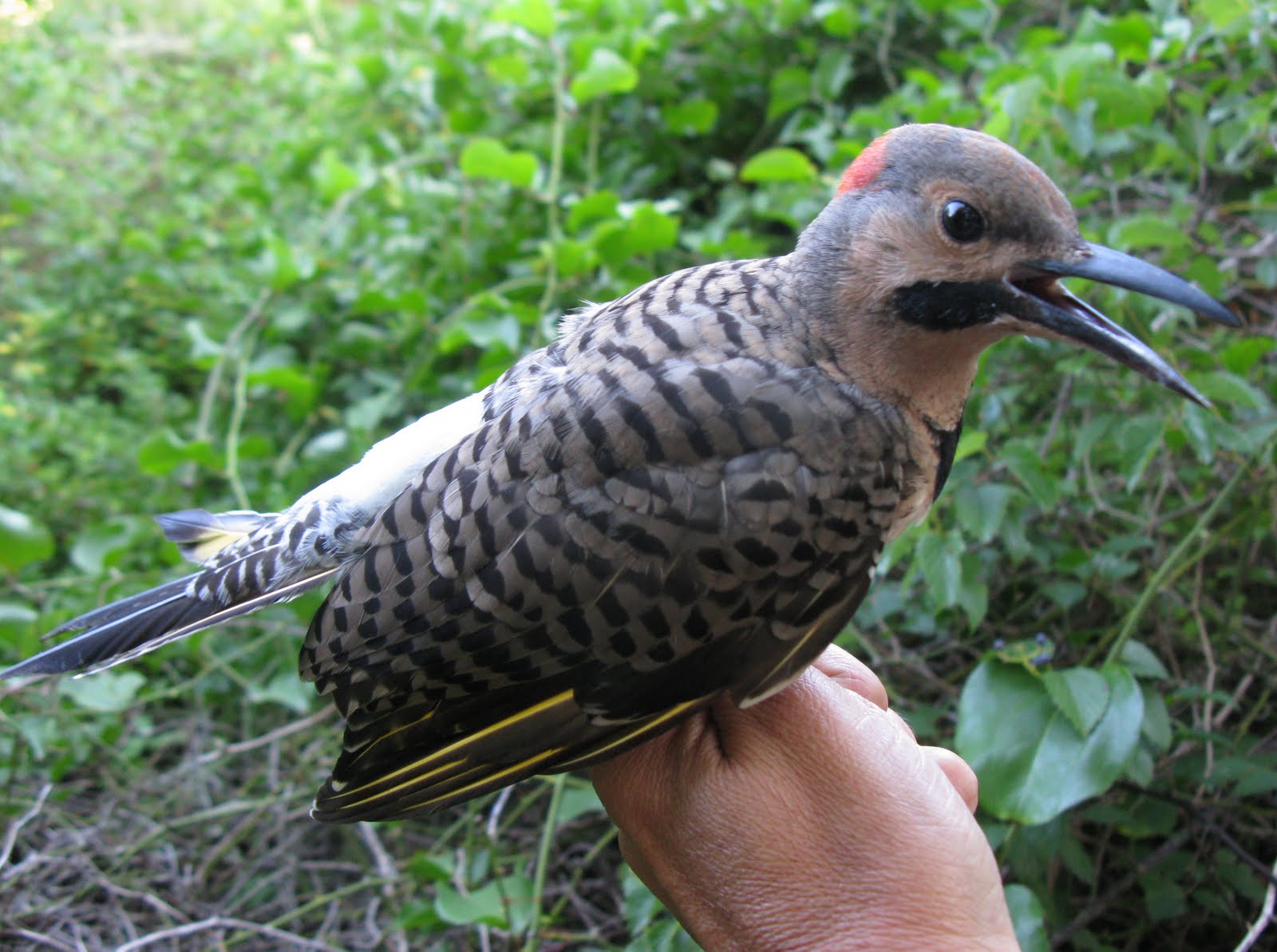
These are hefty birds and weigh at least 10x what a chickadee weighs, barely fitting on our scale. Notice the beautiful yellow coloring to the shafts of their wings and tails. Their western counterparts have red coloration in place of the yellow. Here is the flicker getting weighed which takes only a few seconds.

We’ve had plenty of Baltimore Orioles these past two weeks both in our nets and in my hummingbird trap at my home. Below is an adult male looking quite fresh as he finishes up his annual molt.

They scoff down hummingbird nectar so fast I’m constantly filling the feeders. Orioles flock together in large groups this time of year. This adult female has black spots on her back and head.

This young male oriole was especially bright from munching on Tartarian honeysuckle berries.

The best bird of the day from Thursday August 5th was a beautifully plumaged adult male Blue-winged Warbler just finishing up his molt. Besides insects, he may have been munching on the same berries as the oriole above with his orange tinged feathers.


We had a good variety of birds on Saturday, Aug 7th with 20 species banded and we handled a whopping 53 catbirds. Our first hatch year kingbirds appeared

and numerous young towhees.

Before their first pre-basic molt we can sex hatch year towhees by their tail color, black in males

and brown in females.

We also captured another adult Ovenbird looking a bit ratty going through its annual molt


and our first White-breasted Nuthatch for the year, a hatch year male.

The combination of black, white, and bluish-gray feathers is so pretty isn’t it? While there is no shortage of these nuthatches, we don’t capture them very often.

Also making an appearance on Saturday was a young House Wren

and a first year female Hairy Woodpecker who was extremely uncooperative getting her picture taken. The best I could do was a bit blurry photo

and my fingers paid dearly for the effort! OUCH!

On Wednesday, August 11th, I banded in North Eastham in the National Seashore. I had a contract job with a group of researchers studying the reasons behind the lower incidence of Lyme disease in the south compared with other parts of the country. They needed a bander who could mist net birds and remove ticks. Five nets were set up in one of their plots where they are also sampling mammals, rodents, and reptiles (reptiles mainly in other parts of the country). We met before dawn and opened nets as the sun rose. They had set up nets the night before in the woods and we caught nothing for the first two hours. After scouting out the area I suggested we move a couple of nets to a more appropriate area, more shrubby than woodsy, and from then on we had birds every net round. We did resort to a bit of clowning around we were so happy to finally get some birds.
Eric releasing a Hermit Thrush
 |
Eric is a wildlife biologist contracted to help them with the other wildlife they are sampling. Two students from the University of Rhode Island learned about bird banding and helped to band birds and remove ticks. Here is Justin releasing a Blue Jay. |

Both Justin and Amanda took turns looking for ticks on the birds:

We handled fourteen birds for the morning with half of those being hatch year Hermit Thrushes.
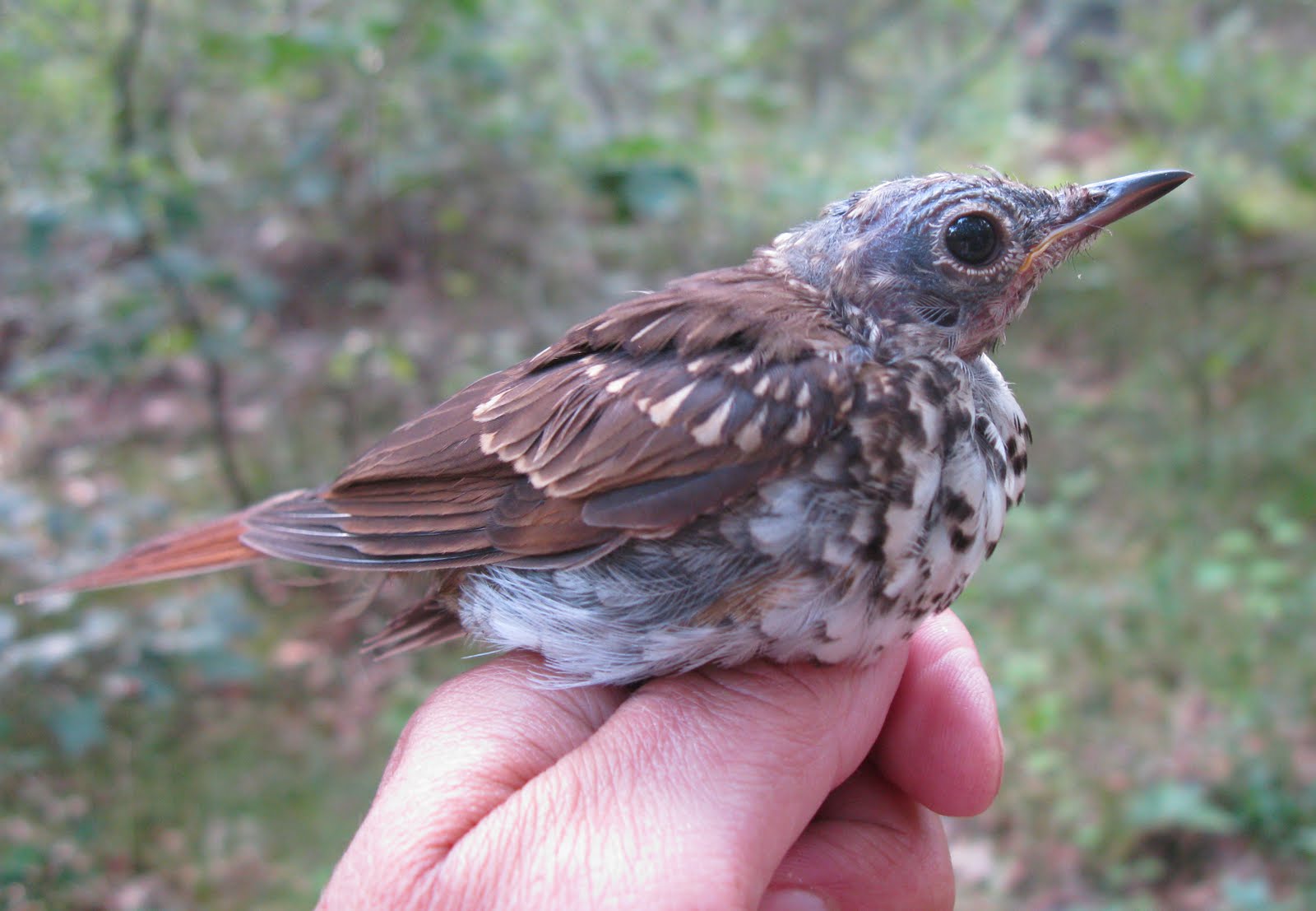
Most of them were molting body feathers. Notice the hole under the bird’s eye- that is actually the ear!

The reddish tail is characteristic of Hermit Thrushes, who breed on Cape Cod. They have one of the most beautiful songs of all our songbirds.

Amanda found an interesting, brilliantly colored spider she shared with us found in the leaf litter. Apparently it is called an Arrow-shaped Micrathena (female).

I had an enjoyable morning with a fun group of people. Seated is Jean Tsao, the lead investigator from the University of Michigan and Howard Ginsberg, another researcher and professor at URI is standing next to her.

The following day I banded another hatch year Red-eyed Vireo back in Brewster at the banding station.

I also captured the Gray Catbird with the grossly deformed bill I spoke about in my last post. It weighed only a gram less than last time, but felt emaciated in my hand.
We netted more Northern Waterthrushes on Saturday, Aug 14th.

Our first American Redstart for the year showed up today too, a hatch year female.

Below is a comparison of eye color in an adult Northern Mockingbird that we caught today. Adults have a yellowish tinge to the iris. She also had a slightly deformed bill.

The young mockingbirds have a grayish coloration to their iris which will gradually turn yellow as they age.

The best bird on Saturday was a hatch year Mourning Warbler of unknown sex, but probably female. She was just passing through on her southerly migration journey to build up some fat reserves. She had some fat on her, but will probably stick around for a few days before moving on.

Monday, August 16th proved questionable weather-wise, but Judith and I gave it a try only opening enough nets that we could handle in case the rain come in faster than expected. Luckily with technology today I’m able to keep an eye on the radar on my phone and we had a successful morning with just a wee bit of rain that didn’t amount to anything and had a good number of birds for our effort- 63. We had nothing new in the way of birds but Judith did catch something other than a bird. She quickly called me on the two-way radio so I could run down and take a picture. It was a Long-tailed Weasel! Judith remembers a buffy coloring to the undersides, which would indicate weasel rather than mink. All I can say is good thing Gretchen wasn't there!

As usual I’m grateful to the volunteers who helped out at different times throughout the last two weeks- Gretchen Putonen, Judith Bruce, Carolyn Kennedy, Roger Mongold, and the Johnson family- Sheryl and her daughters, Lauren and Kristen. The following birds were seen, heard, or captured during 1 – 16 August. Numbers reflect captured birds only.
Total banded species: 31 Birds/100 net-hours: 96
Double-crested Cormorant
Great Blue Heron
Green Heron
Osprey
Black-bellied Plover
Least Sandpiper
Laughing Gull
Ring-billed Gull
Herring Gull
Great Black-backed Gull
Mourning Dove
Black-billed Cuckoo
Great Horned Owl
Ruby-throated Hummingbird -20
Belted Kingfisher
Downy Woodpecker -5
Hairy Woodpecker -2
Yellow-shafted Flicker -2
Traill's Flycatcher -1
Eastern Phoebe -12
Great Crested Flycatcher -4
Eastern Kingbird -9
Tree Swallow
Barn Swallow
Blue Jay -1 (in Eastham)
American Crow
Fish Crow
Black-capped Chickadee -46
Tufted Titmouse- 3
Red-breasted Nuthatch
White-breasted Nuthatch -1
Carolina Wren -4
House Wren -3
Hermit Thrush -7 (in Eastham)
American Robin -6
Gray Catbird -200
Northern Mockingbird -4
Cedar Waxwing
European Starling -5
Red-eyed Vireo -1
Blue-winged Warbler -1
Yellow Warbler -7
Prairie Warbler -1
American Redstart -1
Ovenbird -1
Northern Waterthrush -2
Mourning Warbler -1
Common Yellowthroat -36
Northern Cardinal -5
Eastern Towhee -9
Saltmarsh Sparrow
Song Sparrow -52
Baltimore Oriole -20
Purple Finch
House Finch -1
American Goldfinch
House Sparrow


